
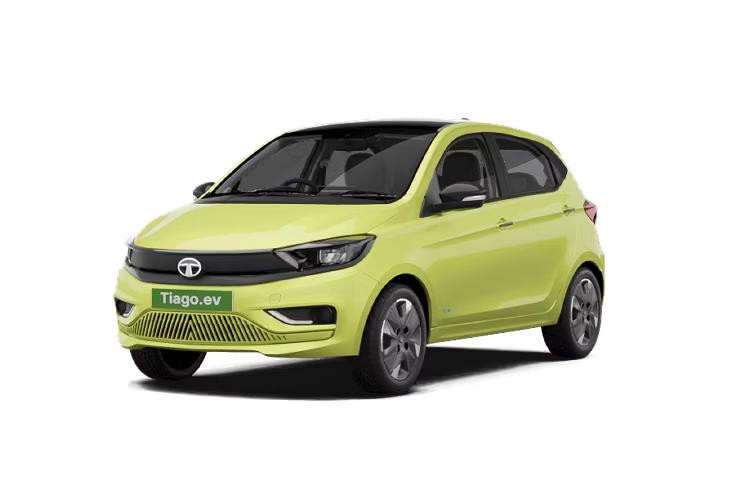
The Tata Tiago EV state subsidy 2026 looks different depending on which state you register the car in—and that gap can run well above Rs 1.5 lakh. If you’re buying India’s most affordable electric car right now, knowing those numbers before you walk into the showroom can save you real money.
The 2026 Tiago EV just got a full generation update. Tata launched it at Rs 6.99 lakh (ex-showroom)—down from the earlier starting price of Rs 7.99 lakh. It comes with either a 19.2 kWh or a 24 kWh battery pack, six airbags, a 360-degree camera, and the option of a Battery-as-a-Service (BaaS) plan starting at Rs 4.69 lakh plus Rs 2.6 per km. For anyone considering a first EV, this is probably the most practical entry point in India today.
But the on-road price is where state policy kicks in—and the three states in question handle it very differently.
Table of Contents
How the Tata Tiago EV State Subsidy 2026 Breaks Down by State
Maharashtra: Road Tax Gone, But Private Car Subsidy Has Changed
Maharashtra runs the most ambitious EV policy among Indian states right now. Its 2025–2030 plan has Rs 11,373 crore behind it and targets 30% EV penetration by 2030.
Here’s the part that matters for private buyers: 100% road tax exemption and zero registration charges for all EVs registered in Maharashtra. On a car priced around Rs 7–10 lakh, road tax alone typically runs Rs 50,000 to Rs 80,000. That saving shows up directly in your on-road bill.
The direct cash subsidy picture has shifted, though. Under the updated 2025–2030 policy, the Rs 1.5–2 lakh four-wheeler subsidy now applies primarily to fleet and taxi operators, not private buyers. The quota covers 25,000 transport-category EVs. Private individuals buying a Tiago EV in Maharashtra in 2026 still benefit heavily from road tax and registration waivers — but should not count on a direct cash transfer unless they are registering a commercial vehicle.
Maharashtra also offers toll exemptions on major expressways, including the Mumbai–Pune route. For daily commuters, that’s a recurring saving that adds up fast over a year.
Gujarat: Up to Rs 1.5 Lakh for Four-Wheelers, Lowest Road Tax in India
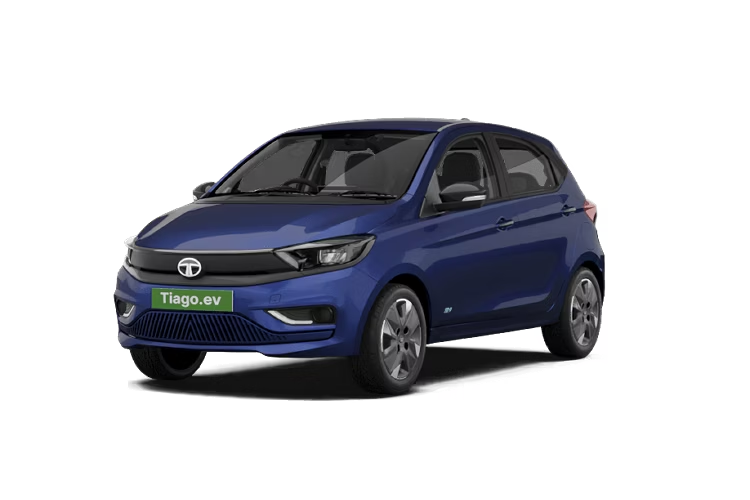
Gujarat consistently ranks among the best states for EV buyers. The state offers a direct purchase subsidy of up to Rs 1.5 lakh for electric four-wheelers, road tax set at just 1% (valid through 2026 under the current policy), and 100% exemption from electricity duty for home EV charging.
One detail that matters for Tiago EV buyers: the Rs 1.5 lakh subsidy applies to the long-range 24 kWh variant. The medium-range 19.2 kWh base model, in some cases priced below Rs 10 lakh after discounts, may fall outside the subsidy criteria depending on the current policy notification. Confirm this with your dealer before purchase. Tiago EV production for Gujarat also happens at Tata’s Sanand facility, which can affect delivery timelines positively.
Gujarat also runs a 25% capital subsidy for public charging infrastructure—so the charging network in cities like Ahmedabad and Surat continues to grow, which eases range anxiety for new EV owners.
Karnataka: No Direct Subsidy, But Real Savings on Registration and Tax
Karnataka was the first Indian state to announce an EV policy back in 2017. In 2026, it does not offer direct purchase subsidies to private buyers. What it does offer: road tax exemption on first registration and a waiver of registration charges—both of which knock a meaningful amount off the on-road price.
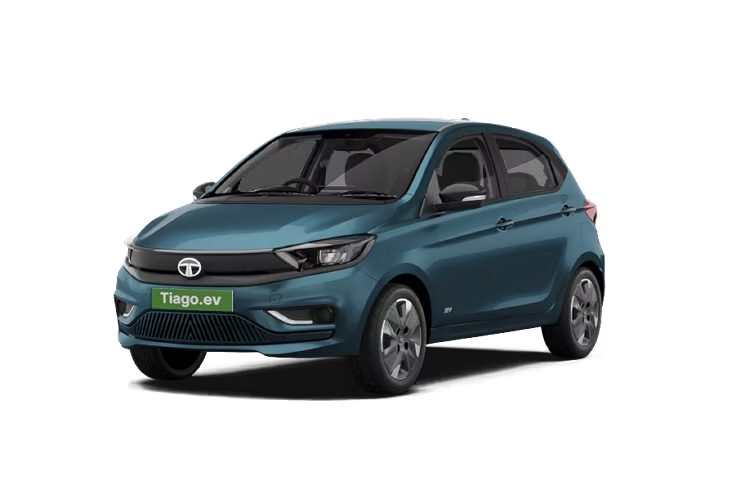
The on-road price for a base Tiago EV Smart 19 in Bengaluru comes to approximately Rs 7.64 lakh, which includes RTO charges of around Rs 34,950 and insurance of Rs 30,553. The road tax figure is lower than in many other states because of Karnataka’s EV exemption.
Karnataka makes up for the absence of direct subsidies through infrastructure. The state mandates EV chargers every 3 km in Bengaluru, reserves 10% of parking spaces in high-rise buildings for EVs, and has invested Rs 1,500 crore in public-private charging corridors with Tata Power and Statiq. Charging tariffs run between Rs 5 and 6 per kWh. For Bengaluru buyers covering 40–60 km daily, the math on running costs still works heavily in the Tiago EV’s favor.
State-by-State Comparison: What You Actually Save in 2026
| State | Direct Purchase Subsidy | Road Tax | Registration Fee | Toll Benefit | Charging Infrastructure |
|---|---|---|---|---|---|
| Maharashtra | Up to Rs 2 lakh (fleet/taxi only) | 100% exempt | 100% waived | Toll exemption on major routes | Mandatory in new buildings |
| Gujarat | Up to Rs 1.5 lakh (LR variant) | 1% (approx. Rs 7,000–15,000) | Partial relief | Not specified | 25% capital subsidy for public chargers |
| Karnataka | None for private buyers | Exempt on first registration | Waived | None | Charger every 3 km in Bengaluru |
What Central Schemes Add on Top
The PM E-DRIVE scheme runs alongside state policies. For electric four-wheelers eligible under FAME-II criteria—which includes the Tiago EV at its current price point—central demand incentives apply. The Tiago EV’s 19.2 kWh and 24 kWh packs both qualify for the Rs 10,000 per kWh central incentive structure, subject to the scheme’s active deadlines and budget availability.
All EVs in India also attract 5% GST instead of the 28–43% applicable to petrol and diesel cars. That alone represents a significant reduction in the base price compared to an ICE hatchback in the same segment.
The BaaS Option Changes the Calculation Entirely
Tata introduced the Battery-as-a-Service plan with the 2026 Tiago EV. You buy the car without the battery at Rs 4.69 lakh (ex-showroom) and pay Rs 2.6 per km of usage. For someone driving 800–1,000 km per month, this keeps the entry cost very low. BaaS also shifts battery degradation risk away from the buyer entirely.
State subsidies under BaaS work differently — confirm eligibility with your state’s nodal agency before choosing this route.
Real Running Cost: Why the Subsidy Conversation Matters
Charging a Tiago EV with a 24 kWh pack at home in Karnataka costs roughly Rs 120–150 per full charge at BESCOM domestic tariff rates. That covers the 280–290 km ARAI range (around 220–240 km real-world). Compare that with a petrol hatchback spending Rs 600–700 for the same distance. The monthly fuel saving for a 1,000 km/month commuter runs between Rs 4,000 and Rs 5,500.
The 8-year / 1.6 lakh km battery warranty on the 19.2 kWh pack and the lifetime unlimited-km warranty on the 24 kWh pack (for the first registered owner) remove the biggest EV ownership anxiety that most buyers bring into the showroom.
How to Claim the Subsidy: The Practical Steps
For Gujarat and Maharashtra subsidies, the general process works like this. Your dealer typically assists with the paperwork at the time of purchase. You need an Aadhaar card, PAN, proof of address, the purchase invoice, and the vehicle registration certificate. The subsidy amount is credited to your bank account within 30–90 days of approval depending on the state.
Maharashtra’s subsidy disbursement for fleet operators runs through the state transport department. Private buyers need to verify which exact benefits apply to their registration type when speaking to the dealer—the road tax and registration waiver apply automatically at the RTO; the cash subsidy does not.
Karnataka has no separate subsidy application process for private buyers beyond what happens at the RTO level.
ALSO READ: Tata Tiago EV AC Not-Cooling Problem Fix: What’s Really Going On and How to Sort It.
ALSO READ: Can We Use The Tata Punch EV as a Taxi? Real Running Cost, Range & Profit Explained
ALSO READ: Tata Tiago EV Common Problems 2026 (Real Owner Reports)
What to Confirm Before You Buy
Subsidy policies are quota-based and can be withdrawn once limits are hit. Maharashtra caps the transport-category EV subsidy at 25,000 four-wheelers. Gujarat’s policy has an end date tied to its current EV notification. Check with your dealer on the specific date and confirm that the Tiago EV variant you want is on the state’s approved model list.
Also verify which variant qualifies. The 24 kWh long-range variant consistently qualifies for the higher subsidy tier in states that use battery capacity as the eligibility metric. The 19.2 kWh base variant sometimes falls below the price or capacity threshold used by certain state schemes.
Conclusion
The Tiago EV state subsidy in 2026 is not a simple flat number—it’s a combination of direct payments, tax waivers, registration fee savings, and infrastructure benefits that vary by state. Gujarat gives the most visible direct saving for private buyers at up to Rs 1.5 lakh on the four-wheeler subsidy plus near-zero road tax. Maharashtra gives the most comprehensive road tax and registration relief for private buyers and significant subsidies for fleet operators. Karnataka gives no direct cash but handles infrastructure well enough that real-world EV ownership in Bengaluru is practical and affordable.
The updated 2026 Tiago EV at Rs 6.99 lakh starting price, combined with whichever state benefits apply to you, makes this the most financially accessible electric car in India right now. Run the numbers for your specific state, variant, and use case—then talk to your dealer about what has been officially claimed by other buyers in your city. The paperwork is manageable. The savings are real.
Data sourced from Tata Motors, Autocar India, Bolt.Earth, Ecozaar.in EV Subsidy Guide 2026, Maharashtra Transport Department, and Karnataka BESCOM tariff data.

Dattu Siddi is a Commerce graduate and automobile content writer with over 2 years of blogging experience. Based in Yellapur, Uttara Kannada (Karnataka), he focuses on delivering accurate, easy-to-understand car information using real-world calculations and practical comparisons. Through cardekho24, Dattu publishes clean, user-first automotive content—especially around EVs, budget cars, ownership costs, and real-life usage—to make car research simple, transparent, and trustworthy.