
The Tata Tiago EV common problems 2026 are something every potential buyer should understand before signing the dotted line. This car is charming, affordable, and genuinely fun in the city. But real owners across Indian forums have flagged some persistent issues that Tata hasn’t fully resolved yet.
The Tiago EV launched in September 2022 and quickly became India’s most affordable electric hatchback. Its price, practicality, and Tata’s brand trust made it an obvious first EV for thousands of families. Three years in, a substantial body of real-world ownership data has emerged—and the picture is mostly positive but with some genuine red flags.
This article draws on documented owner experiences from Team-BHP, Autocar India’s long-term test reports, and MouthShut user reviews. No filler, no guesswork — just what actual owners have reported.
Table of Contents
The HV Critical Alert: The Biggest Problem by Far
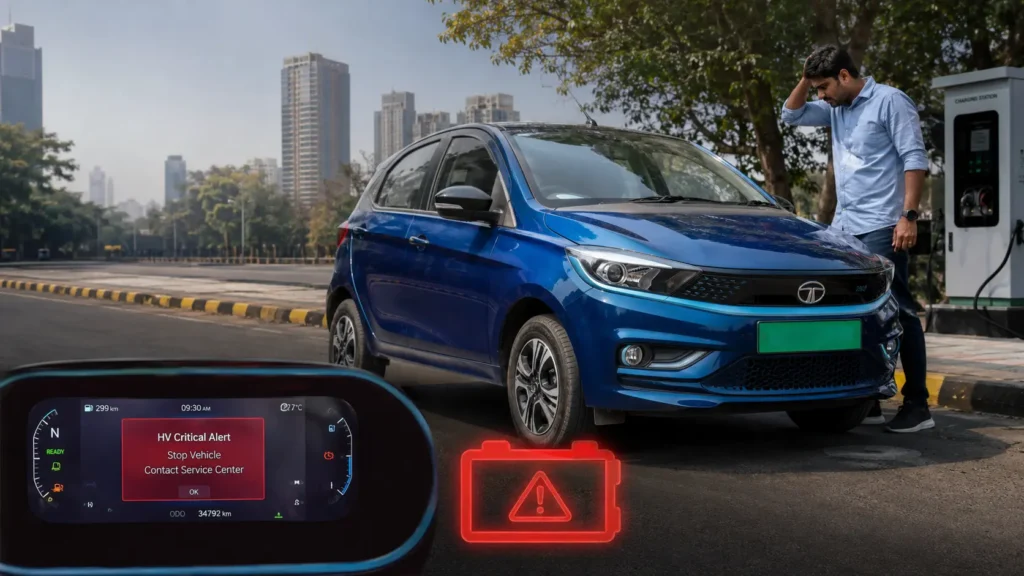
If you spend any time in Indian EV owner communities, you’ll run into this. The “HV Critical Alert” (High Voltage Critical Alert) is the most documented and talked-about problem with the Tiago EV. It’s not rare. Multiple owners on Team-BHP have experienced it, some more than once.
What happens: the car throws a high-voltage error, loses power, and becomes undrivable on the spot. One owner described being at 8,500 km on his car when the HV alert appeared while slowing down for a speed breaker. The car went into a fail-safe mode and had to be towed. Later it restarted—but the issue returned multiple times.
“Each time this is reported to Tata service centers, they keep the car for 2-3 days, clear some errors, and do some software calibration, then return the car. In almost all cases, the issue returns almost immediately.” — BHPian AKINA, Team-BHP, 2024 (owner with 40,000 km on Tiago EV LR)
What causes it? According to a detailed Team-BHP community analysis, the HV error is a generic flag for any anomaly in the car’s high-voltage architecture. Three main triggers have been identified: improper charging practices (the biggest one), incompatible public chargers — especially BPCL, HPCL, and IOCL units that don’t reduce power at high charge states — and, in fewer cases, actual battery cell issues.
The fix Tata applies is a full battery pack replacement under warranty. One owner, at 45,000 km, had his motor control unit and HV wiring harness replaced. The owner, at 55,000 km, drove fine for a year, then the alert returned and needed a full battery swap. Some owners have had 2 or even 3 replacements. The battery has an 8-year, 1.6-lakh km warranty, so Tata does cover it—but the weeks without your car and the uncertainty are genuinely frustrating.
Owner tip: Several Tiago EV owners report that keeping regen set to 0 when experiencing HV alert symptoms reduces recurrence. Also avoid public chargers from BPCL, HPCL, and IOCL if you’ve faced the error before. These aren’t official Tata advisories—they’re crowd-sourced fixes from owners who’ve lived through it.
Real-World Range vs Claimed Range
Tata claims 315 km for the 24 kWh long-range variant. Real-world owners and Autocar India’s long-term test tell a different story. With a full charge in mixed city and highway conditions, the actual range sits around 187-220 km. On a highway run at 80-100 km/h, range drops faster than the onboard estimate suggests.
Autocar India’s 5,500 km long-term review documented a Mumbai-to-Pune run on a single charge—just barely, with about 10% battery remaining. The driver described it as a stressful, watchful drive. The Tiago EV made it, but it’s clearly not a car that lets you relax on a highway.
The medium-range 19.2 kWh variant claims 250 km. Real-world figures sit closer to 150-170 km. Factor in India’s ambient heat, AC use, and traffic, and this battery pack feels tight for anything beyond a controlled city loop.
AC and Electrical Niggles
Multiple owners have reported the air conditioning failing without any obvious cause. In one detailed Team-BHP account, an owner’s AC stopped working, and the service center couldn’t find the root cause initially. It later emerged that the VCU (Vehicle Control Unit) and HVAC software had not been flashed after a previous sensor replacement—a service oversight that caused real grief.
The same owner documented a charging glitch: the car simply wouldn’t start charging, requiring a “retry ritual” to get it to accept charge. These electrical gremlins appear to trace back to the car’s software rather than hardware, but the distinction barely matters when your car is in the workshop for the third time in a month.
Other reported electrical issues include intermittent warning lights, regen settings that don’t hold after a restart on some units, and the infotainment system occasionally needing a hard restart.
Tata Tiago EV Common Problems 2026: Data Table
Here’s a structured overview of the most reported Tata Tiago EV common problems, compiled from owner forums and long-term test data.
| Problem | How Common | Severity | Tata’s Response | Warranty Covered? |
|---|---|---|---|---|
| HV Critical Alert / Battery failure | Frequently reported across forums | High — car immobilised | Battery pack replacement; software calibration | Yes—8 yr / 1.6 L km |
| Real-world range shortfall | Universal — all variants | Medium — affects usability | No fix; inherent limitation | No |
| AC malfunction / HVAC software fault | Reported by multiple owners | Medium — discomfort in heat | Software re-flash; sensor replacement | Yes—within warranty period |
| Charging failure / car won’t accept charge | Occasional, linked to public chargers | High when stranded | Software update; charger compatibility advisory | Partial—charger-related excluded |
| Infotainment lag / crash | Mild; more common on pre-2025 units | Low — inconvenience only | OTA or manual software update | Yes |
Most complained-about issues among Tiago EV owners (based on forum thread frequency, Team-BHP & Autocar India community data)
HV Critical Alert
88%
Range shortfall vs claim
76%
AC / HVAC issues
42%
Charging failures
38%
Infotainment glitches
24%
These figures represent relative complaint frequency in documented owner communities, not failure rates per 100 units.
Service Centre Experience: Hit or Miss
This is where the Tago EV’s story gets complicated. The car itself isn’t catastrophically unreliable, but Tata’s service network for EV-specific problems is inconsistent. Dealers in smaller cities sometimes lack EV-trained technicians. Multiple owners report service centers clearing error codes and returning cars without a real fix—only for the same fault to reappear within days.
For major issues like the HV alert, Tata does engage its engineers directly and has approved full battery replacements without charging owners. That’s genuinely good. The frustration is the turnaround time: battery packs aren’t stocked at dealerships, so replacements can take five days or more. If the Tiago is your only car, that’s a real problem.
ALSO READ: Tata Tiago EV and Tata Punch EV for Taxi: Which Makes More Profit in 2026?
ALSO READ: Tata Tiago EV State Subsidy 2026: What Buyers in Maharashtra, Gujarat, and Karnataka Actually Get
ALSO READ: Can We Use The Tata Punch EV as a Taxi? Real Running Cost, Range & Profit Explained
The 2026 Update: Does It Fix Anything?
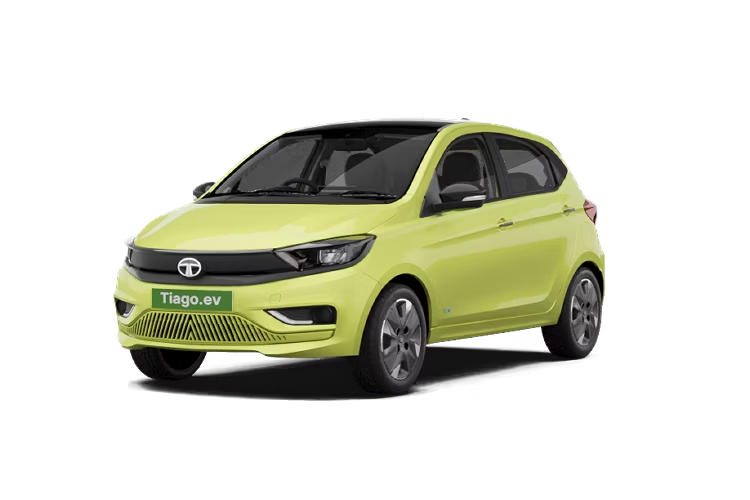
Tata launched the updated 2026 Tiago EV in late May 2026 at Rs 6.99 lakh. The update brings a redesigned exterior, a refreshed interior, a 10.25-inch infotainment screen with wireless Android Auto and Apple CarPlay, and faster DC charging that claims to add 100 km in 18 minutes. The 24 kWh battery now carries a lifetime HV battery warranty for the first owner.
The lifetime warranty is meaningful. It signals Tata’s acknowledgement that the battery is the car’s weakest point—and their commitment to stand behind it. Whether the underlying HV alert issue has been resolved at the cell chemistry or BMS level isn’t publicly confirmed yet. Early 2026 owner reports aren’t available in volume at this time.
Who Should Still Buy the Tata Tiago EV?
The Tiago EV makes the most sense for buyers with a home charger, a daily commute under 60 km, and either a second car or good public transport backup. If you’re in a metro city with Tata Power or Ather charging points nearby, you’re in a better position than someone in a Tier-2 city relying on PSU pumps.
The car’s ride, refinement, and running costs are genuinely impressive. Autocar India’s reviewers consistently note how smooth and polished the drive feels for its price. The problems are real—but so is the value at Rs 7-9 lakh for a five-star NCAP-rated electric car with a strong warranty.
First-time EV buyers who want a worry-free experience might consider waiting six months for 2026 model ownership data to accumulate. Patient buyers with home charging will likely be happy. Buyers who need their car to just work every single day with zero drama—the Tiago EV is not quite there yet.
Final Takeaway
The Tata Tiago EV’s common problems in 2026 center on one recurring culprit: the high-voltage battery alert. It’s real, it’s documented, and Tata replaces batteries under warranty—but weeks without your car aren’t a minor inconvenience. Range shortfall vs claimed figures is a close second. The AC and charging software issues are less widespread but show a pattern of electrical gremlins that Tata’s service network hasn’t always handled well.
That said, thousands of owners drive their Tiago EVs daily without incident. For a city commuter with home charging, it remains one of the best-value EVs in India. Go in with eyes open, understand the warranty terms, and if possible, join an owner community before buying. Real owners will tell you more than any brochure ever will.

Dattu Siddi is a Commerce graduate and automobile content writer with over 2 years of blogging experience. Based in Yellapur, Uttara Kannada (Karnataka), he focuses on delivering accurate, easy-to-understand car information using real-world calculations and practical comparisons. Through cardekho24, Dattu publishes clean, user-first automotive content—especially around EVs, budget cars, ownership costs, and real-life usage—to make car research simple, transparent, and trustworthy.