
Can We Use the Tata Punch EV as a Taxi? The short answer is yes, you can. But whether you should depends on how you run your cab business, which city you operate in, and how much you actually understand about EV ownership costs.
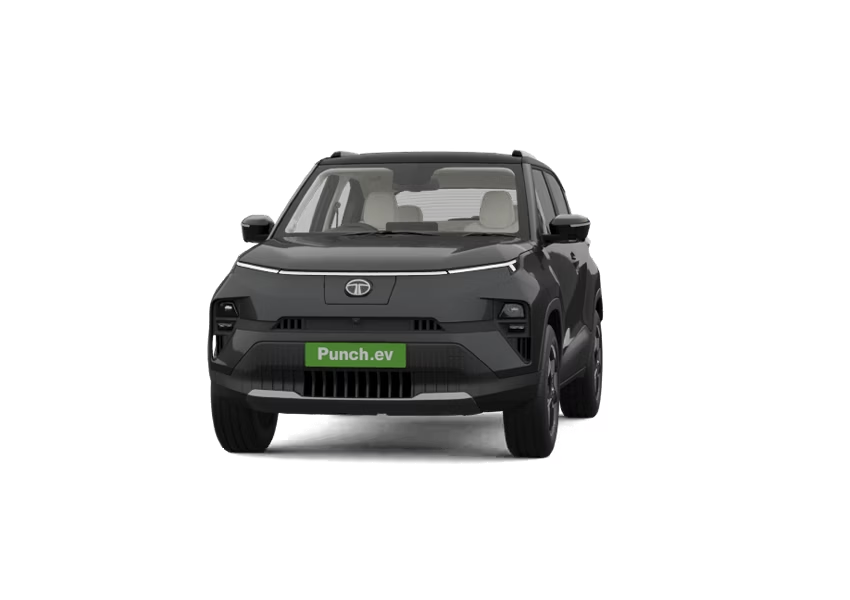
The Tata Punch EV has been getting serious attention from fleet operators and first-time EV cab owners since it launched in early 2024. It’s priced from around Rs 10.99 lakh (ex-showroom), it has a peppy city driving feel, and its running cost per kilometer sits somewhere between Rs 0.80 and Rs 1.20, depending on where you charge it. That’s roughly 4 to 5 times cheaper per kilometer than a petrol cab like a Maruti Swift or Hyundai Grand i10 Nios.
So the economics look attractive on paper. But taxi usage is brutal on a car. It’s 200 to 300 km a day, multiple passengers, constant AC, and a charging infrastructure that still isn’t uniformly reliable across India. You need to look at this carefully.

Table of Contents
The range question
The Punch EV comes in two battery options. The long-range pack gives you 421 km of claimed ARAI range. In real-world city driving with AC on, passengers aboard, and a mix of slow traffic and highway stints, expect around 270 to 320 km per charge.
For most city taxi operators doing 8-to-10-hour shifts, that’s workable. If you’re covering Mumbai, Bengaluru, Hyderabad, or Delhi NCR, and you can top up at a public charger or at home between shifts, one charge per day is enough.
The Short Range variant, at around 315 km claimed (roughly 200 to 230 km real-world), is tighter. If your shift is on the longer side or you do airport runs regularly, that range could leave you anxious by evening.
Stick to the Long Range if you’re serious about using this as a taxi.

Charging time and infrastructure
This is the real operational challenge. Using a 7.2 kW AC home charger, a full charge on the Long Range pack takes around 6 to 7 hours. That’s fine if you charge overnight and start fresh every morning.
DC fast charging (50 kW) brings it to 80% in about 56 minutes. That’s usable for a midday top-up if you’re near a Tata Power or ChargeZone station. But if you’re in a Tier 2 or Tier 3 city or in areas where charging stations are sparse and often occupied or under maintenance, this becomes a genuine problem.
Operators in cities like Pune, Chennai, and Bengaluru have reported reasonably smooth experiences with the Punch EV because public charging density there is higher. In smaller cities, fleet operators are solving this by installing a 7.2 kW wallbox at their home or garage.
If you’re buying this as a taxi and you don’t have a home charging solution, the math gets complicated fast.
ALSO READ: Tata Punch EV Advantages and Disadvantages: The Real Ownership Experience in India
Running cost breakdown
At Rs 8 per unit (kWh) and the long-range pack’s real-world consumption of roughly 14–15 kWh per 100 km, you’re spending about Rs 1.10 to Rs 1.20 per km on energy. Add Rs 0.25 to Rs 0.35 per km for maintenance (the Punch EV has no clutch, no gearbox wear, minimal brake wear due to regenerative braking), and your total running cost is roughly Rs 1.40 to Rs 1.60 per km.
A CNG cab running on piped CNG at current rates in a metro comes to around Rs 2.80 to Rs 3.20 per km. Petrol is even higher, at Rs 5 to Rs 6 per km.
Over 80,000 km a year, that difference compounds. An EV cab operator saves roughly Rs 1 to Rs 3 per km versus petrol, which is Rs 80,000 to Rs 2.4 lakh annually in fuel costs alone. That’s significant.
The Punch EV’s battery warranty is 8 years or 1.6 lakh km, whichever comes first. That’s a meaningful protection for taxi use.

Comfort and space: Does it work for passengers?
The Punch EV is a sub-4-meter SUV. Rear seat space is decent for 2 passengers but tight for 3. Legroom is adequate but won’t impress on longer rides. The boot space is 366 liters, enough for a couple of airport bags.
For intra-city ride-hailing on platforms like Ola, Uber, or Rapido, the Punch EV fits the Mini or Micro category perfectly. For outstation or intercity taxi use where passengers expect more room and range certainty, it’s less ideal.
AC performance is good, and the cabin is relatively quiet at city speeds due to the electric drivetrain. Passengers tend to rate EV cabs highly for ride comfort simply because of the silence and smoothness.
ALSO READ: Using the Tata Tiago EV for Uber/Ola in India—A 6‑Month Owner’s Reality Check
Aggregator platform eligibility
Tata Motors has tie-ups with multiple fleet financing partners and has pushed the Punch EV for commercial use. On Ola and Uber, the vehicle is eligible for registration in the Mini category in most metro cities.
One thing to check before buying: your city’s RTO rules on commercial EV registration. Some states offer a full road tax exemption on EVs, including commercial variants. Delhi, for instance, waives road tax and registration fees on EVs, which reduces your upfront cost by Rs 20,000 to Rs 40,000 depending on the variant.
Some state governments also offer FAME II subsidies on EVs registered for commercial use. The eligibility criteria vary; it’s worth checking the current status with your local dealer before finalizing a purchase.
Depreciation and resale
This is the honest part most EV sales pitches gloss over. EV resale value in India is still uncertain, especially for used taxis with high odometer readings. A 3-year-old Punch EV taxi with 2.5 lakh km on the clock will face tough questions about battery health from any used-car buyer.
Tata’s battery warranty helps. But the resale market for high-mileage EV cabs hasn’t matured yet. If you plan to sell the car after 4 to 5 years, factor in that you may get less than you’d expect compared to a petrol equivalent.
ALSO READ: Tata Punch EV Interior Features: What Makes the Cabin Stand Out?
Who should buy For Can We Use The Tata Punch EV as a Taxi?
If you’re operating in a metro or Tier 1 city with a reliable home charging setup and doing 200 to 250 km shifts, the Punch EV makes solid financial sense. The fuel savings are real, the maintenance costs are lower, and passenger comfort is good enough for the ride-hailing segment.
If you don’t have home charging, operate in a city with thin charging infrastructure, or need the car for outstation taxi work regularly, the Punch EV will create friction. The economics are still better than petrol, but the operational headaches will wear you down.
The car works. The infrastructure question is what you need to answer for yourself before writing the cheque.

Dattu Siddi is a Commerce graduate and automobile content writer with over 2 years of blogging experience. Based in Yellapur, Uttara Kannada (Karnataka), he focuses on delivering accurate, easy-to-understand car information using real-world calculations and practical comparisons. Through cardekho24, Dattu publishes clean, user-first automotive content—especially around EVs, budget cars, ownership costs, and real-life usage—to make car research simple, transparent, and trustworthy.