
The Tata Tiago EV and Tata Punch EV are two of the most popular electric vehicles in India right now. If you’re buying one for taxi work, the decision isn’t about which car looks better — it’s about which one earns more money and breaks down less.
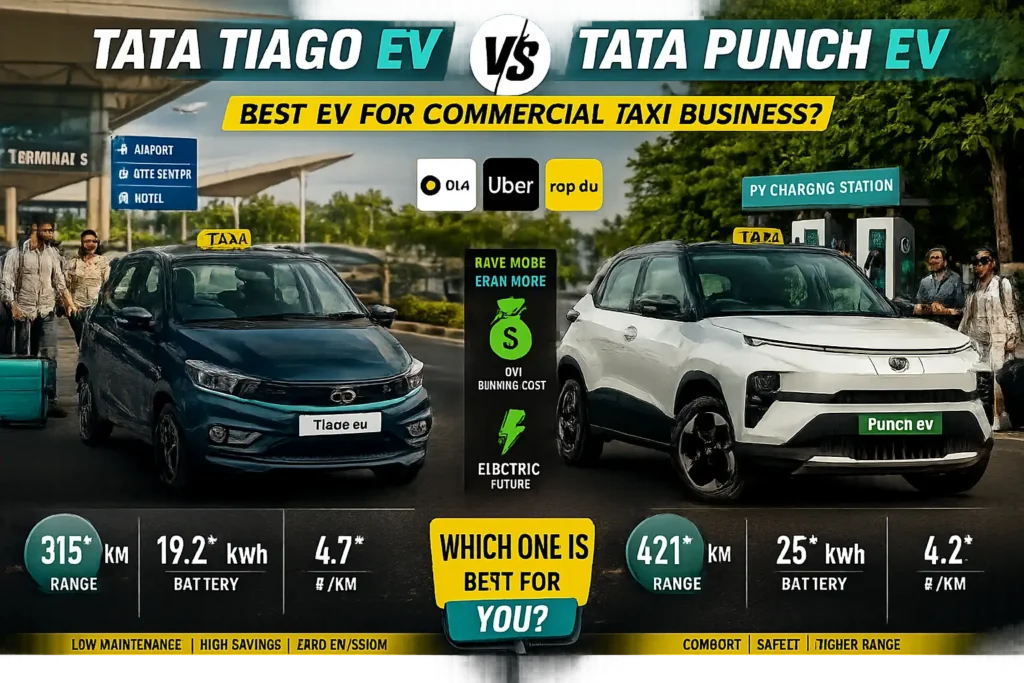
I’ve spent time going through ownership data, real-world range tests, driver feedback, and Tata’s own published specifications to help you make a clear call. No guesswork here. Let’s get into it.
Table of Contents
The core difference: what kind of taxi work are you doing?
Before comparing specs, ask yourself one honest question: How many kilometers do you drive in a day, and mostly where?
If your routes are inside a city—airport pickups, local rides, school runs—the Tiago EV handles that comfortably. If you’re doing mixed city-highway work or covering 200+ km a day, the Punch EV’s larger battery becomes genuinely useful, not just a nice-to-have.
This single factor decides most of what follows.
Price and upfront cost
The Tiago EV (facelift, May 2026) starts at Rs 6.99 lakh ex-showroom. The Punch EV starts at Rs 6.49 lakh for the BaaS (Battery as a Service) variant, though that’s with a monthly battery subscription. A straightforward Punch EV with ownership of the battery starts higher—the Empowered Plus S 40 kWh variant goes up to Rs 12.59 lakh.
For most taxi operators buying mid-range variants, the Tiago EV Long Range sits around Rs 9.99 lakh, while a comparable Punch EV variant costs Rs 10.99 lakh upwards. That’s roughly an Rs 1 lakh difference, which, on a taxi loan, matters.
Cost edge: Tiago EV. A lower entry price means a lower EMI, which directly affects your monthly profit from day one.
Range — the number that actually matters
Tata claims the Tiago EV Long Range delivers 285 km per charge (ARAI). In real-world tests with AC running and mixed traffic, Autocar India’s data shows around 187 km on the 24 kWh pack. That’s honest and still workable for a city-heavy taxi driver covering 150–180 km a day.
The Punch EV with its 30 kWh battery claims 365 km, and the 40 kWh version goes further. Real-world figures sit closer to 280–310 km depending on AC use and load. For a taxi driver doing long airport runs or intercity trips, that buffer removes the anxiety of watching a battery percentage drop in the middle of a fare.
Range edge: Punch EV. If you do 200+ km a day or run highway routes, the Punch EV’s range keeps you out of charging stations during peak hours. That’s money in your pocket.
Running cost per kilometre
This is where both cars win against petrol and CNG — but not equally against each other.
Based on electricity at Rs 10 per unit (standard commercial tariff), the Tiago EV 24 kWh costs around Rs 1.28 per km at ARAI efficiency, or closer to Rs 1.60–1.80 per km in real use. The Punch EV, being heavier and slightly less efficient, runs at Rs 1.70–2.00 per km in real conditions.
The Tiago EV is lighter (around 1,177 kg curb weight), and its smaller motor uses power more efficiently in stop-start city conditions. If you’re doing short city runs, that efficiency gap adds up over 30,000 km a year.
Efficiency edge: Tiago EV for pure city work. The Punch EV costs slightly more to run per km, though its larger battery means fewer charge cycles over time.
Passenger space and comfort—your riders judge this
Taxi passengers notice two things fast: headroom and legroom. The Punch EV, being a micro-SUV with a height of 1,622 mm and a wheelbase of 2,445 mm, gives rear passengers noticeably more headroom and a more commanding seating position. Its boot space is 366 liters—enough for two large bags plus a carry-on without arguments.
The Tiago EV is a hatchback. Rear space is adequate for two adults on city runs. Boot space is 240 liters—good for grocery trips, tighter for airport luggage. Taller passengers seated in the back may feel the roof pressing closer, especially on longer rides.
If you’re on Ola, Uber, or running a local cab service where passenger reviews matter, the Punch EV’s cabin feel works in your favor. Passengers perceive SUVs as more premium, even when both cars cost roughly the same.
Passenger comfort edge: Punch EV. The higher roofline, more boot space, and SUV feel generate better rider ratings — which means more rides.
Safety and ground clearance
The Punch EV has earned a 5-star Bharat NCAP safety rating. Its ground clearance is 190–195 mm, which handles broken city roads, speed bumps, and flooded patches better than the Tiago EV’s lower hatchback ground clearance.
The Tiago EV has not been tested under the same Bharat NCAP framework at the time of writing. It does get 6 airbags in higher variants, which is a strong point for safety-conscious buyers.
Safety and road-handling edge: Punch EV. Better ground clearance protects the battery pack on bad roads—critical for a commercial vehicle clocking 40,000+ km a year.
Charging time—dead time is lost income
The Tiago EV takes about 58 minutes for a 10–80% charge on a 25 kW DC fast charger. The Punch EV does the same job in around 26 minutes on the 40 kWh variant. That’s over half an hour of difference per charge cycle.
A taxi that charges twice a day saves an hour of dead time if it runs the Punch EV. On busy days, that’s one or two extra fares.
Charging edge: Punch EV. Faster DC charging keeps you on the road longer during a working day.
Side-by-side comparison
| Factor | Tata Tiago EV (LR) | Tata Punch EV (30 kWh) | Real-World Impact | Winner |
|---|---|---|---|---|
| Starting price | Rs 6.99 lakh | Rs 9.69 lakh (owned) | Lower EMI, faster break-even | Tiago EV |
| ARAI range | 285 km (24 kWh) | 365 km (30 kWh) | Fewer charges per day | Punch EV |
| Real-world range | ~187 km | ~280–310 km | Highway route suitability | Punch EV |
| DC fast charge (10–80%) | ~58 minutes | ~26 minutes | Less downtime per shift | Punch EV |
| Boot space | 240 litres | 366 litres | Airport luggage handling | Punch EV |
| Ground clearance | ~165 mm | 190–195 mm | Battery protection on rough roads | Punch EV |
| City efficiency | ~7.77 km/kWh | ~6.8–7.2 km/kWh | Lower cost for short city runs | Tiago EV |
Sources: Autocar India real-world range test, Tata Motors official specifications, and CarDekho, ZigWheels, and 91Wheels verified data (2024–2026).
Who should buy the Tiago EV for a taxi?
The Tiago EV makes the most sense if your daily distance stays under 150 km, your routes are inside one city, and keeping the initial loan low is a priority. City driving suits its smaller motor well — the efficiency is genuinely better in traffic, and the lower price means you break even faster.
One real owner on CarWale noted driving 42,000 km in a year on the Tiago EV, which speaks to its durability for high-mileage use. The catch: they also mentioned the seats get uncomfortable on 150 km daily averages. That’s worth knowing before signing the loan papers.
If you’re driving 200 km or more a day, doing airport runs, handling luggage regularly, or operating in an app-based taxi service where rider ratings affect your income, the Punch EV justifies its higher cost. The larger boot, better ground clearance, and faster charging add real value that shows up as more rides completed per shift.
Who should buy the Punch EV for a taxi?
The 5-star Bharat NCAP rating also matters for fleet operators buying multiple vehicles—lower insurance costs and better safety outcomes both affect the bottom line.
Best for
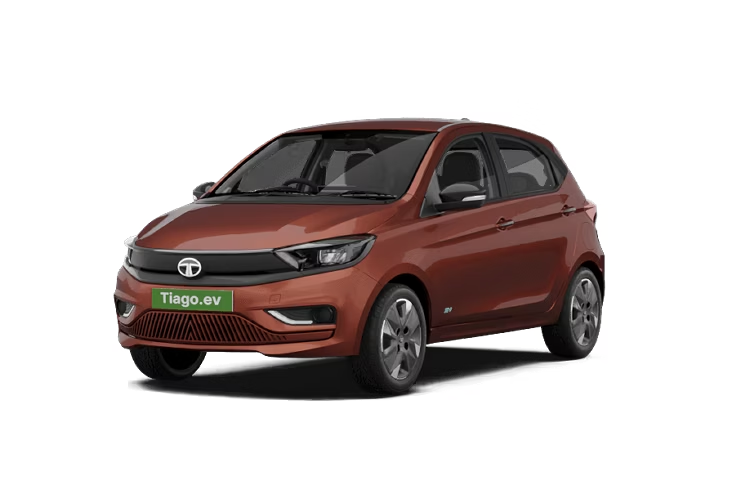
Tiago EV
City-only routes under 150 km/day. Budget-conscious first-time EV buyers. Solo driver operations where passenger perception matters less than unit economics.
Best for
Punch EV
Mixed city-highway runs. App-based taxi services with passenger ratings. Operators handling airport luggage, longer daily distances, or rough city roads.

The bottom line
For pure taxi use across most Indian cities, the Tata Punch EV wins on almost every practical count—more range, faster charging, better boot space, higher safety rating, and stronger passenger perception. Those factors directly affect daily earnings.
The Tata Tiago EV isn’t a bad taxi car. It’s a smart one in specific conditions: tight budget, short urban routes, and cost-per-km discipline. If you’re stretching a loan to buy a cab, the Tiago EV’s lower EMI gives you breathing room in slow months.
There’s no universally correct answer—but there is a right answer for your specific route, budget, and rider base. Use the comparison table above to map your situation, and choose the car that earns more in your particular city, not the one that sounds better in a showroom.

Dattu Siddi is a Commerce graduate and automobile content writer with over 2 years of blogging experience. Based in Yellapur, Uttara Kannada (Karnataka), he focuses on delivering accurate, easy-to-understand car information using real-world calculations and practical comparisons. Through cardekho24, Dattu publishes clean, user-first automotive content—especially around EVs, budget cars, ownership costs, and real-life usage—to make car research simple, transparent, and trustworthy.