
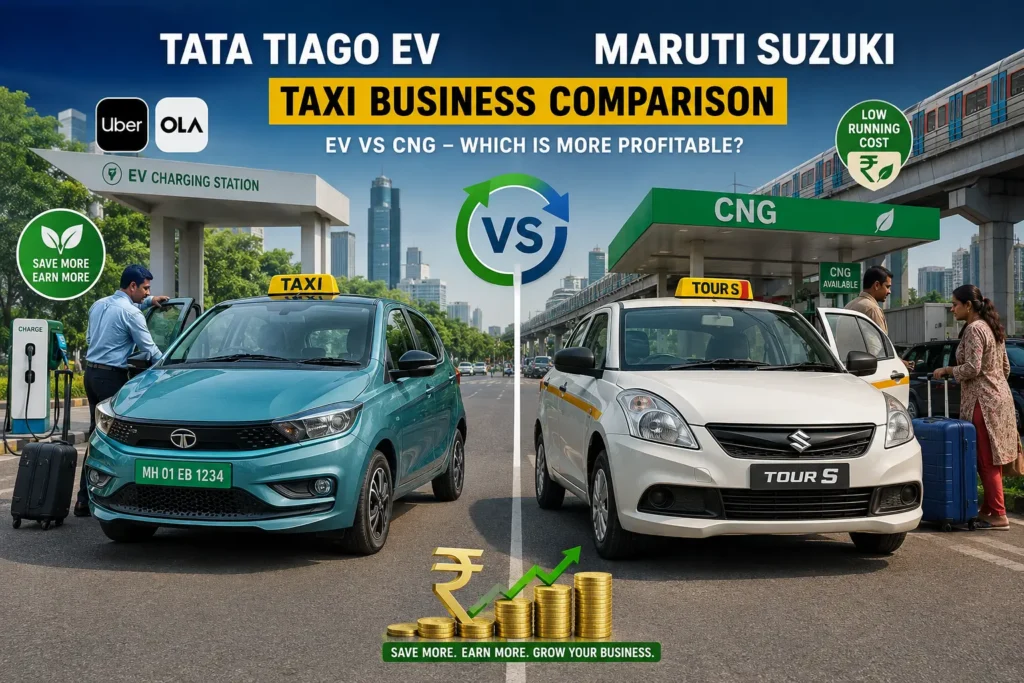
Tata Tiago EV vs. Swift Dzire is one of those comparisons that keeps popping up in cab driver WhatsApp groups, fleet owner meetings, and YouTube comment sections. And honestly, it makes sense. One runs on electricity and costs almost nothing per kilometer. The other has been the cab industry’s backbone for over a decade. So which one actually makes more money for you? Let’s get into it.
Now I have solid data. Let me write the article and create the comparison table as a widget.
| Factor | Tata Tiago EV (24 kWh) | Maruti Dzire Tour S (CNG) | Winner (Commercial Use) |
|---|---|---|---|
| Ex-showroom price | ₹7.99 lakh – ₹11.79 lakh | ₹6.24 lakh – ₹7.10 lakh (CNG) | Dzire Tour SLower upfront cost, easier to finance |
| Running cost per km | ₹0.82 – ₹1.50/km Home charging vs public DC fast charging | ₹2.26–₹3.50/km for CNG at ₹70–90/kg | The Tiago EV3 is 4x cheaper per km at-home charging |
| Claimed range / tank | 285 km (ARAI) / ~190–215 km real-world | 34.30 km/kg CNG: tank ~60 L petrol + CNG Refill anywhere in minutes | Dzire Tour SNo range anxiety; CNG stations widely available |
| Maintenance cost | Very low—no oil, clutch, or exhaust Service under ₹1,000 per visit (owner data) | Moderate—oil changes, CNG kit service, clutch wear on high mileage | Tiago EV: EVFewer wear parts = lower annual spend |
| Passenger comfort (commercial) | 5-seater hatchback; rear legroom modest | 5-seater sedan; 382 L boot, better rear legroom, standard cab body type, familiar to riders | Dzire Tour Sedan form preferred in taxi/outstation market |
Table of Contents
Why Commercial Buyers Think Differently
A private car buyer worries about looks, features, and weekend road trips.
A commercial buyer has one question: how much money does this car make or lose every month?
That changes everything. Boot space, rear legroom, ease of refueling, driver fatigue, resale value, and monthly EMI all carry far more weight than a sunroof or a fancy touchscreen.
Both cars try to answer that question differently. The Tiago EV cuts your fuel bill dramatically. The Dzire Tour S (the official commercial variant of the new 4th-gen Dzire) gives you a proven formula that India’s taxi market already understands.
The Money Argument: Running Cost Is Where the EV Wins Hard
At an electricity rate of ₹10 per unit and a daily run of around 60 km, the Tata Tiago EV’s running cost works out to roughly ₹0.85 per km.
The Maruti Swift Dzire Tour (older variant) had a running cost of ₹2.26 per km on CNG, assuming CNG at ₹70 per kg. The new Tour S with its updated Z12E engine is a bit more efficient, but the gap against an EV remains wide.
That difference adds up. If you drive 200 km a day—a reasonable target for a city cab—the Tiago EV costs roughly ₹170 in electricity. The Dzire Tour S CNG costs closer to ₹450 at the same distance. That’s a saving of ₹280 per day, or about ₹8,400 per month, just on fuel alone.
Over a year, that’s over ₹1 lakh back in your pocket. Over 3 years, you’ve more than recovered the price difference between the two cars.
The Purchase Price Reality Check
The Tiago EV’s ex-showroom price starts at ₹7.99 lakh for the base XE MR variant.
The 2025 Maruti Tour S (commercial Dzire) starts at ₹6.79 lakh for petrol and ₹7.74 lakh for the CNG variant.
So on paper, the Tour S CNG is cheaper to buy. But the Tiago EV’s lower running cost closes that gap in roughly 14 to 18 months of full-time commercial use. After that, the EV is ahead on total cost of ownership.
The catch? Finance. Banks still treat EVs as riskier assets than proven petrol or CNG models. Getting a loan for the Tiago EV at a commercial rate can be trickier, especially for first-time fleet buyers. The Dzire gets loans faster, with better terms, at more dealerships.
Tata Tiago EV vs Swift Dzire for Commercial Use: The Range Problem You Can’t Ignore
The Tiago EV’s 24 kWh battery has an ARAI-rated range of 293 km, though real-world testing returned around 187 km on a combined cycle.
For city cab use under 150 km a day, that’s fine. You charge overnight at home, drive the next day, and you’re done.
But for outstation cab work, rentals, or inter-city routes? It gets complicated. You’re dependent on charging infrastructure, which is still inconsistent outside major metros. A full charge via the standard 3.3 kW wall box takes 8 to 9 hours. The faster 7.2 kW AC charger adds 100 km of range in about 18 minutes with DC fast charging. Still, it requires planning in a way the Dzire does not.
The Dzire Tour S CNG returns a certified mileage of 34.30 km/kg, and CNG filling takes 5 minutes at any pump. For drivers who do long hours, multiple shifts, or cover districts rather than city lanes, that reliability matters a lot.
Comfort and the Passenger Experience
Here’s where the Dzire has a built-in advantage: form factor.
India’s cab riders are used to sedans. They expect a proper boot for luggage. They expect to sit in the back without their knees touching the front seat.
The new Tour S gets a 382-liter boot, which handles airport luggage, outstation bags, and grocery runs without drama.
The Tiago EV is a hatchback. The boot is smaller. Rear passengers get slightly less legroom. For quick city rides on Uber or Ola, it’s absolutely fine, but for outstation hiring or premium cab aggregators, a sedan wins the passenger confidence vote every time.
Maintenance: EV’s Silent Advantage
This is where the Tiago EV quietly builds a case for itself over 3 to 5 years.
No engine oil. No clutch cable. No exhaust pipe. No timing belt. EVs have fewer mechanical parts that wear out.
Real owners of the Tiago EV report service costs under ₹1,000 per visit, which is significantly lower than what a CNG car needs after high-mileage commercial use. A cab that does 200 km a day will cover 70,000 km in a year. By year 2, the Dzire’s CNG kit, clutch, and brake system will need meaningful attention. The EV’s brake pads last longer too, because regenerative braking absorbs most of the deceleration.
The one maintenance concern with EVs remains the battery. The Tiago EV battery replacement cost is estimated between ₹4 lakh and ₹5 lakh. Tata does offer a lifetime battery warranty on the 24 kWh pack, which reduces that risk significantly, but it’s still something a commercial buyer has to think about.
Which One Actually Works for Your Commercial Setup?
The honest answer is it depends on how and where you drive.
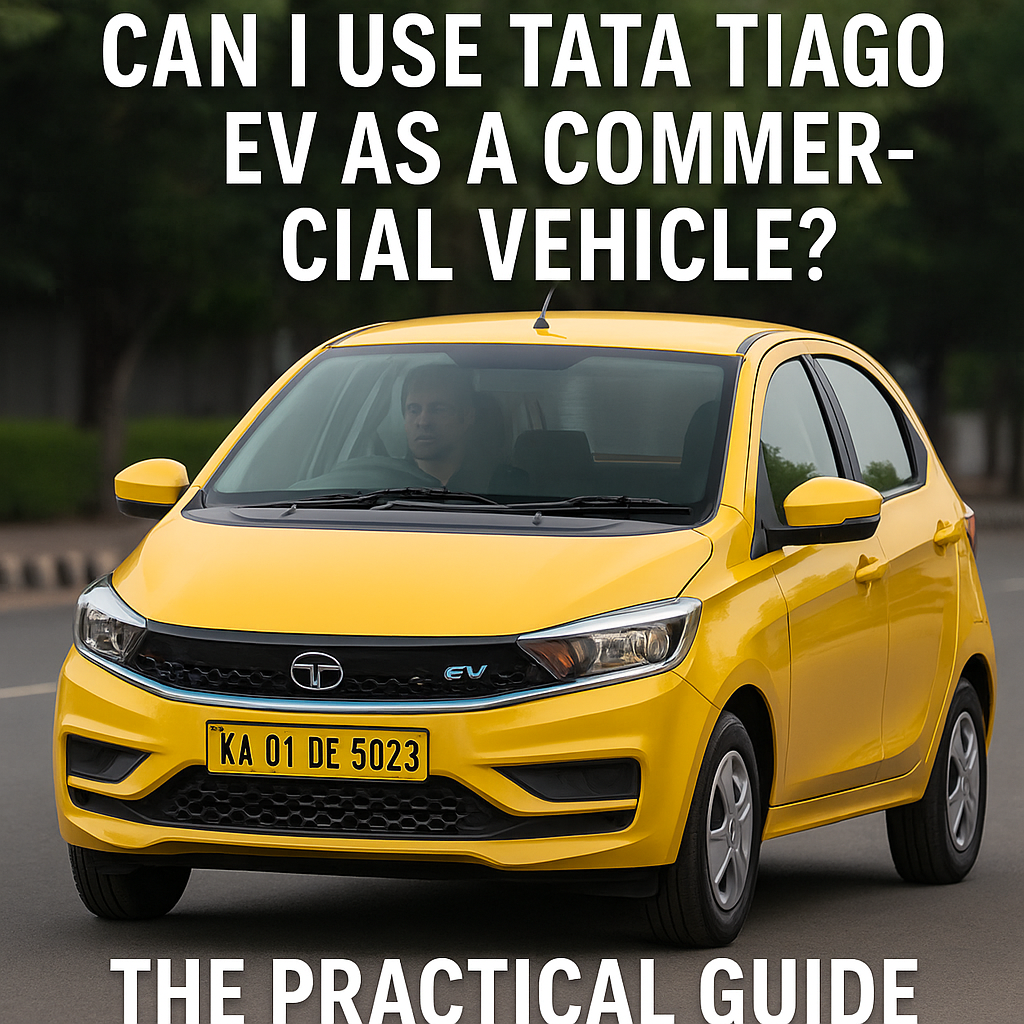
Choose the Tiago EV if you run a city-only cab, charge at home overnight, cover 100 to 180 km per day, and want to cut your monthly running cost in half. Over 3 years, the numbers decisively favor the EV.
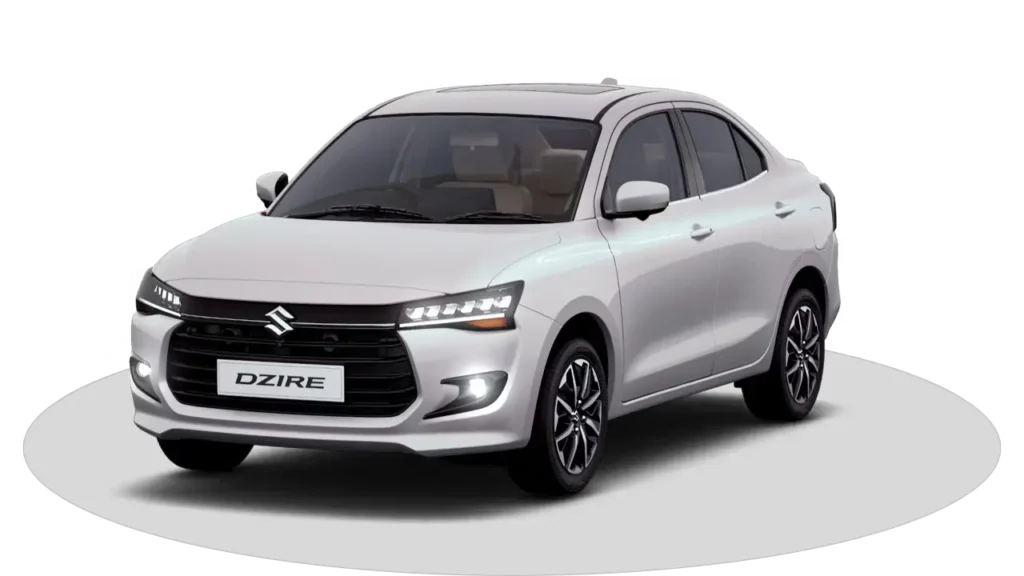
Choose the Dzire Tour S CNG if you do outstation trips, multi-city routes, or run a rental where passengers expect sedan comfort. The refuel-in-5-minutes advantage is real. So is the sedan body’s trust factor with passengers.
Tata Motors itself acknowledges that fleet operators like Uber and BluSmart account for roughly 20% of its total EV volumes, which tells you the EV case for commercial use is already proven in cities with good charging infrastructure.
Tata Tiago EV vs Swift Dzire: Final Verdict for Commercial Buyers
There’s no universal winner. But there’s a clearer one for each situation.
For pure city use with home charging, the Tata Tiago EV vs. Swift Dzire math heavily favors the EV after 18 months. The fuel saving alone justifies the slightly higher purchase price, and the lower maintenance cost makes the gap even wider by year 3.
For mixed use, outstation work, and markets where CNG infrastructure is more reliable than EV charging, the Dzire Tour S CNG remains the safer, simpler bet. It’s lighter on the wallet upfront, easier to finance, and sedan comfort never goes out of style in India’s cab market.
Neither car is wrong. The question is whether your route and your daily operation suit an EV’s rhythm or demand the refuel-anytime freedom that CNG still provides. Answer that honestly, and the right choice becomes clear.
Data sources: Autocar India, CarDekho, Maruti Suzuki Commercial (marutisuzukicommercial.com), Tata.ev, RushLane (2025). All prices are ex-showroom and subject to change.

Dattu Siddi is a Commerce graduate and automobile content writer with over 2 years of blogging experience. Based in Yellapur, Uttara Kannada (Karnataka), he focuses on delivering accurate, easy-to-understand car information using real-world calculations and practical comparisons. Through cardekho24, Dattu publishes clean, user-first automotive content—especially around EVs, budget cars, ownership costs, and real-life usage—to make car research simple, transparent, and trustworthy.