
Can We Use the Tata Punch EV as a Commercial Taxi? is one of those questions that sounds simple but has a genuinely layered answer. If you’re an owner thinking about earning with your Punch EV or a fleet buyer doing the math before pulling the trigger, this article covers the full picture—regulations, running costs, charging realities, and the honest trade-offs nobody tells you upfront.
Table of Contents
What Makes It Worth Considering Can We Use the Tata Punch EV as a Commercial Taxi? Taxi Use
Let’s start with the numbers that actually matter.
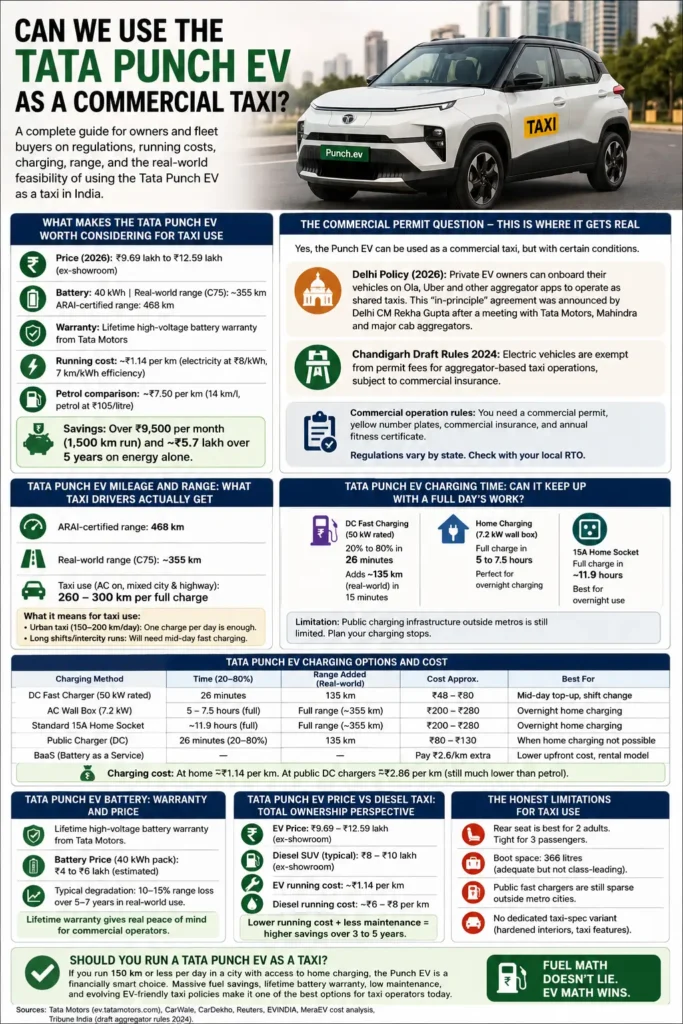
The 2026 Tata Punch EV starts at ₹9.69 lakh (ex-showroom) and goes up to ₹12.59 lakh for the top variant. That’s a car with a 40 kWh battery, a real-world C75 range of around 355 km, and a lifetime high-voltage battery warranty built in—from Tata Motors directly.
For a taxi operator, the running cost calculation is where the Punch EV gets genuinely interesting. At India’s average residential electricity rate of ₹8 per kWh and the car’s real-world efficiency of roughly 7 km per kWh, you’re looking at approximately ₹1.14 per km in energy cost. A comparable petrol car at 14 km/L with petrol at ₹105/liter costs around ₹7.50 per km. That’s over 6 times more expensive per kilometer.
Over 1,500 km per month — a modest taxi run — that gap adds up to roughly ₹9,500 in monthly savings on fuel alone. Over 5 years, that’s close to ₹5.7 lakh saved purely on energy.
The Commercial Permit Question — This Is Where It Gets Real
Here’s where most articles stop giving you straight answers. Can the Punch EV run as a commercial taxi? The answer is yes, but with conditions.
In India, any vehicle operating commercially—picking up paying passengers—must carry a commercial permit and be registered under the commercial vehicle category. This typically involves yellow number plates, commercial insurance, and a fitness certificate renewed annually.
However, policies are shifting. In early 2026, Delhi announced that private EV owners can onboard their vehicles onto aggregator apps like Ola and Uber to operate as shared taxis, cutting through much of the traditional permit red tape. This “in-principle” agreement between the Delhi government and Tata Motors, Mahindra, and major cab aggregators was announced by Chief Minister Rekha Gupta following a meeting at the Delhi Secretariat.
Chandigarh’s draft Motor Vehicle Aggregator Rules 2024 also specifically stated that electric vehicles are exempt from permit fees for aggregator-based taxi operations, subject to commercial insurance. That’s a meaningful financial break for anyone running an EV taxi fleet.
If you’re outside Delhi, check with your state’s Regional Transport Office. Regulations vary by state, and some cities still require full commercial registration even for EVs on aggregator platforms.
ALSO READ: Tata Punch Car Parking Size in Feet: Will It Fit Your Garage in 2026?
Tata Punch EV Mileage and Range: What Taxi Drivers Actually Get
The ARAI-certified range for the 2026 Punch EV is 468 km. The real-world C75 range is 355 km. In actual taxi use—AC on, frequent stops, and mixed urban and highway—expect closer to 260 to 300 km per charge.
For an urban taxi doing 150 to 200 km per shift, one charge per day is enough. That’s a workable pattern. For drivers doing double shifts or covering longer intercity routes, the math tightens considerably, and charging stops become part of the daily plan.
The Tata Punch EV mileage in taxi use depends heavily on driving behavior. Regenerative braking helps a lot in stop-and-go city conditions. On a highway run at consistent speed, the range holds up better than most people expect.
Tata Punch EV Charging Time: Can It Keep Up With a Full Day’s Work?
This is the sharpest practical constraint for taxi use.
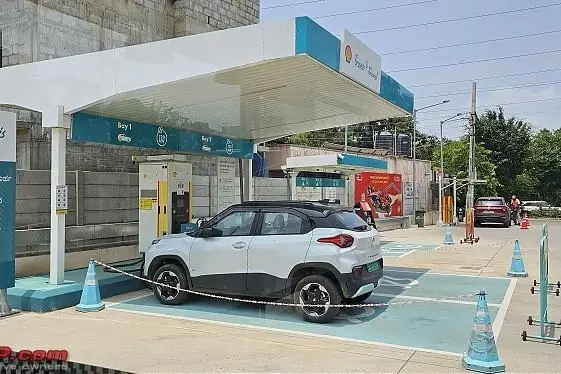
The 2026 Punch EV charges from 20% to 80% in 26 minutes using a DC fast charger. In 15 minutes on a fast charger, you get roughly 135 km of real-world range added. That’s fast enough for a lunch-break top-up or a shift changeover charge.
Home charging via a 7.2 kW wall box takes around 5 to 7.5 hours for a full charge — fine if you’re charging overnight between shifts.
The limitation is India’s public charging infrastructure. Tata’s own charging network is growing, and Tata.ev has been expanding rapidly, but in smaller cities and tier-2 towns, fast chargers are still sparse. For a taxi driver dependent on public fast charging, this is a genuine planning challenge.
| Charging Method | Time (20–80%) | Range Added | Cost Approx. |
|---|---|---|---|
| DC Fast Charger (50 kW rated) | 26 minutes | 135 km (real-world) | ₹48–₹80 |
| AC Wall Box (7.2 kW) | 5–7.5 hours (full) | Full range (~355 km) | ₹200–₹280 |
| Standard 15A Home Socket | ~11.9 hours (full) | Full range | ₹200–₹280 |
| Public Charger (DC) | 26 minutes (20–80%) | 135 km | ₹80–₹130 |
| BaaS (Battery as a Service) | — | Pay ₹2.60/km extra | No upfront battery cost |
Tata Punch EV Charging Cost in Taxi Operations
If you’re charging entirely at home, the Tata Punch EV charging cost per full cycle works out to roughly ₹200 to ₹280 at residential electricity rates of ₹5 to ₹7 per kWh across a full 40 kWh charge.
If you’re relying on public DC fast chargers, rates typically run ₹15 to ₹25 per kWh, which pushes the per-km cost to roughly ₹2.86. Still significantly lower than petrol, but the advantage narrows.
The Battery as a Service (BaaS) option Tata offers is worth understanding for taxi operators. You pay roughly ₹3.2 lakh less upfront for the car but then pay ₹2.6 per km as a battery rental charge. At 150 km per day, that’s ₹390 daily in battery rental alone, which needs to be weighed against the lower purchase cost and the assured buyback terms.
Tata Punch EV Battery Warranty and Battery Price
Tata offers a lifetime high-voltage battery warranty on the Punch EV. This is not a typo or a marketing exaggeration. Tata Motors officially confirmed a lifetime warranty on the HV battery pack for the 2026 Punch EV, which is a genuinely significant factor for any commercial operator.
For reference, if you ever needed to replace the battery outside warranty, the Tata Punch EV battery price for the 40 kWh pack would likely fall in the ₹4 to ₹6 lakh range based on current industry pricing for EV battery packs in India—though with a lifetime warranty, this shouldn’t be your primary concern.
Battery degradation in real-world use over 5 to 7 years typically reduces usable range by around 10 to 15%. For a taxi covering heavy daily mileage, Tata’s warranty coverage matters more than it would for a private owner.
Tata Punch EV Price Compared Against Running a Diesel Taxi
Let’s put the total ownership picture in perspective.
A diesel-powered compact SUV used commercially might cost ₹8 to ₹10 lakh upfront, but the running cost at ₹6 to ₹8 per km adds up fast. Factor in more frequent servicing, oil changes every 5,000 to 7,500 km, and the Punch EV’s lower maintenance needs start making the numbers clearly tilt in its favor.
The Tata Punch EV has no clutch, no gearbox oil, no spark plugs, and no exhaust system requiring periodic attention. Brake wear is lower due to regenerative braking. These aren’t small savings over 3 to 5 years of commercial use.
The Honest Limitations for Taxi Use
The Punch EV isn’t built for very long-shift operations without access to fast charging. The rear seat is comfortable for 2 adults but genuinely tight for 3—so it’s best suited to typical city cab use rather than 5-seater family cab services. Boot space at 366 liters is decent but not exceptional.
The car also lacks a commercial-specific variant with the hardened seat upholstery or dedicated taxi-spec features that some operators prefer. You’re buying a well-equipped passenger car and adapting it to taxi use, which works fine for most urban patterns.
Public charging infrastructure outside metro cities remains the single biggest real-world constraint. If your routes take you beyond a 150 to 200 km radius from reliable charging, plan carefully.
Should You Run a Tata Punch EV as a Taxi?
If you’re in a metro city with access to home charging, the Tata Punch EV taxi case is genuinely strong. The fuel savings alone — potentially ₹8,000 to ₹10,000 per month compared to petrol — combined with the lifetime battery warranty and low maintenance costs make it financially compelling.
The Delhi policy shift allowing private EVs on aggregator platforms removes a major regulatory hurdle for owners who don’t want to go through full commercial registration. If your state follows with similar policies, the barrier drops further.
Check your state’s RTO rules before buying. Confirm the charging access in your operating zone. And if you’re doing 150 km or less per day in an urban area with overnight home charging, the Tata Punch EV as a commercial taxi is not just viable — it’s one of the smartest financial decisions a first-time taxi operator can make right now.
The petrol math simply doesn’t compete anymore.
Sources: Tata Motors official website (ev.tatamotors.com), CarWale, CarDekho, Reuters, EVINDIA, MeraEV cost analysis, and Tribune India (draft aggregator rules 2024).

Dattu Siddi is a Commerce graduate and automobile content writer with over 2 years of blogging experience. Based in Yellapur, Uttara Kannada (Karnataka), he focuses on delivering accurate, easy-to-understand car information using real-world calculations and practical comparisons. Through cardekho24, Dattu publishes clean, user-first automotive content—especially around EVs, budget cars, ownership costs, and real-life usage—to make car research simple, transparent, and trustworthy.
Pingback: Tata Punch EV 2025 Dimensions in Feet, mm, and cm Size Guid
Pingback: Tata Punch EV Performs in Bangalore Traffic City Experience