
Yes, the Tata Tiago EV is worth it for a low daily mileage of 20 km for most urban users. If your daily driving is around 20 km, the car can easily run for several days on a single charge. You spend less on running costs compared to a petrol hatchback, enjoy a quieter driving experience, and avoid frequent fuel station visits. For city commuters, office-goers, and small families, the Tata Tiago EV makes strong financial sense when ownership is planned for several years.
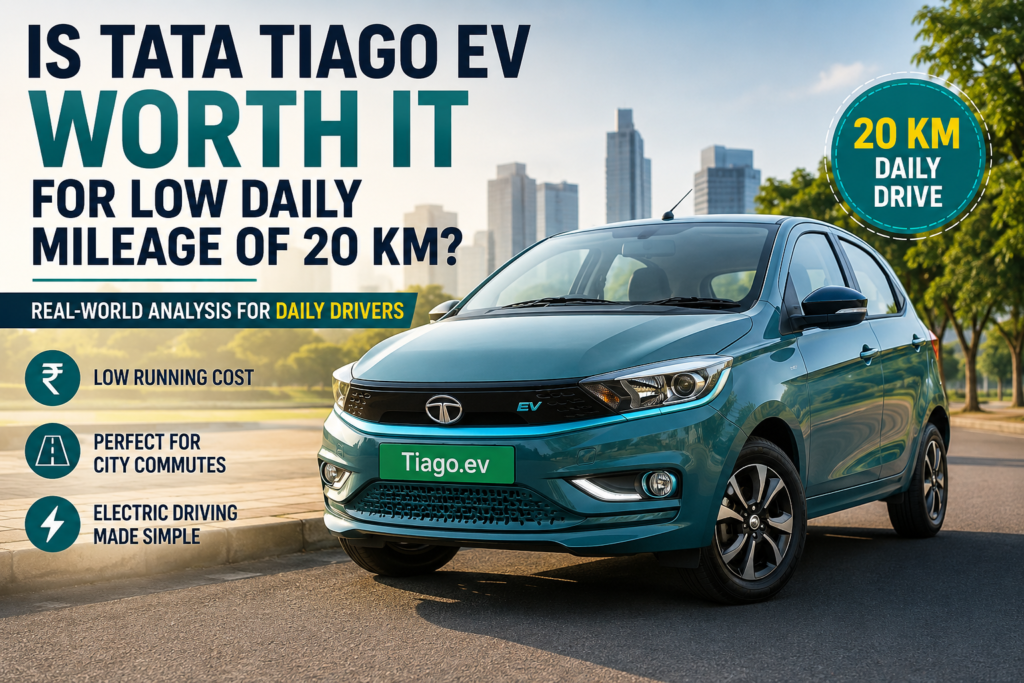
Many buyers assume electric cars only benefit people who drive long distances every day. My experience researching EV ownership patterns in India shows that low-mileage users can still gain from lower maintenance costs, home charging convenience, and protection from rising petrol prices. The key factor is your ownership period. If you plan to keep the car for 5 years or more, the numbers become more attractive.
Table of Contents
Understanding Low Daily Usage and EV Ownership
When people search for Is the Tata Tiago EV Worth It for a Low Daily Mileage of 20 km?, they usually want to know whether the savings justify the higher purchase price.
A daily commute of 20 km equals approximately 600 km per month and around 7,300 km per year. This falls below the average annual usage of many Indian car owners.
The Tata Tiago EV comes with battery options that provide enough range for several days of commuting before requiring a recharge. Most owners can comfortably charge once or twice a week depending on driving conditions and battery variants.
Running Cost Comparison
Fuel savings remain one of the strongest reasons people consider electric vehicles.
| Vehicle Type | Energy Cost per km | Annual Distance | Annual Energy Cost | 5-Year Cost |
|---|---|---|---|---|
| Tata Tiago EV | ₹1.0 – ₹1.5 | 7,300 km | ₹7,300 – ₹10,950 | ₹36,500 – ₹54,750 |
| Petrol Hatchback | ₹6 – ₹8 | 7,300 km | ₹43,800 – ₹58,400 | ₹2,19,000 – ₹2,92,000 |
| Difference | Savings | 7,300 km | ₹33,000+ | ₹1.6 lakh+ |
Approximate calculations based on typical Indian electricity and petrol prices. Actual costs vary by city and usage pattern.
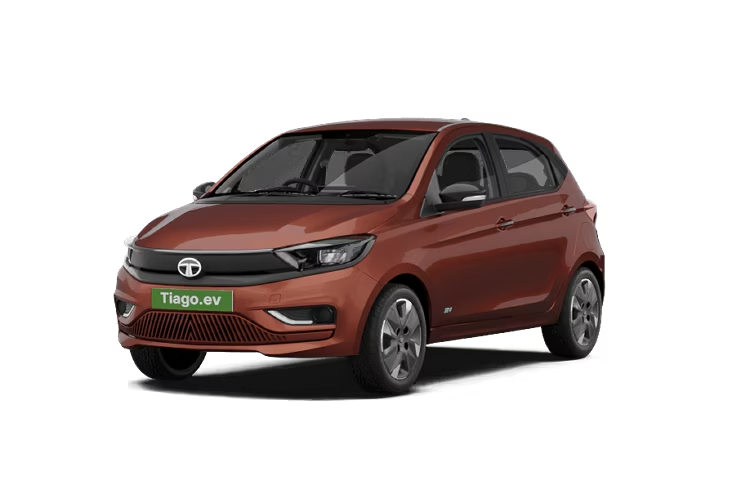
Cost Comparison Graph Style
| Ownership Factor | Tiago EV | Petrol Hatchback | Winner |
|---|---|---|---|
| Running Cost | █████ | ████████████████ | Tiago EV |
| Maintenance Cost | ████ | ██████████ | Tiago EV |
| Long Highway Convenience | ███████ | ██████████ | Petrol |
| City Driving Comfort | ██████████ | ██████ | Tiago EV |
| Home Charging Convenience | ██████████ | N/A | Tiago EV |
Is the Tata Tiago EV Worth It for Low Daily Mileage of 20 km in Cities?
For city driving, the answer is often yes.
Traffic conditions in cities such as Bengaluru, Hyderabad, Pune, and Delhi favor electric vehicles. Frequent stop-and-go driving allows regenerative braking to recover some energy, improving efficiency.
The automatic driving experience also reduces fatigue during traffic jams. Many owners mention this as one of the biggest everyday advantages after switching from petrol cars.
If your typical routine includes office commutes, school runs, shopping trips, and weekend errands, the Tiago EV handles these tasks comfortably.
Charging Convenience Matters More Than Mileage
When evaluating if the Tata Tiago EV is worth it for low daily mileage of 20 km, charging access matters as much as distance traveled.
A home charging setup changes the ownership experience completely. Plugging in overnight removes the need for fuel station visits.
For a person driving only 20 km daily, charging frequency remains low. Many users can drive several days before needing another charge.
Apartment residents should verify charging availability before purchasing. Homeowners generally find the process much easier.
Maintenance Benefits for Low-Mileage Owners
Maintenance savings often receive less attention than fuel savings.
The Tata Tiago EV has fewer moving parts than a petrol vehicle. There is no engine oil, clutch, spark plugs, or many of the routine components that require replacement in conventional cars.
For low-mileage users, maintenance bills usually stay predictable and relatively low throughout ownership.
This benefit becomes more noticeable over a 5 to 8-year ownership period.
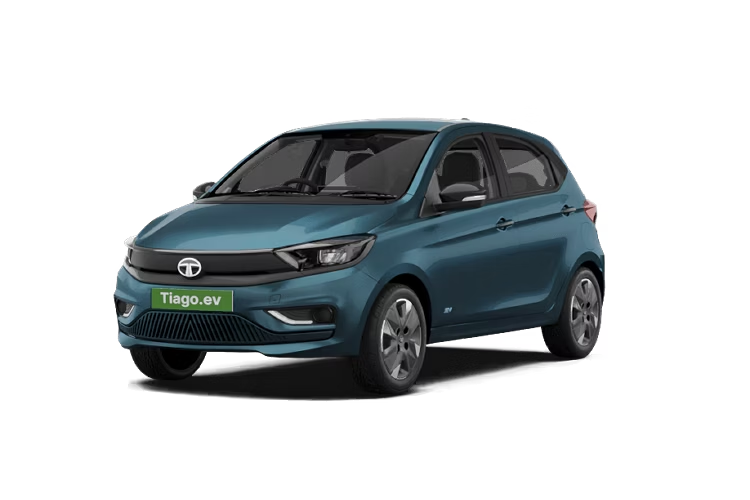
Is the Tata Tiago EV Worth It for a Low Daily Mileage of 20 km Financially?
The financial answer depends on ownership duration.
Someone who changes cars every 2 or 3 years may not recover the full price difference through fuel savings alone.
A buyer planning to keep the vehicle for 5 years or longer generally sees stronger value. Lower running costs, reduced maintenance expenses, and stable daily usability improve the ownership equation.
This is why many urban families now consider EVs even when daily driving distances remain modest.
Also read: Using the Tata Tiago EV for Uber/Ola in India—A 6‑Month Owner’s Reality Check
Also read: The Real Deal on Tata Tigor EV real-world highway range in India: No Sugarcoating, Just Facts
Real-World Ownership Experience
Several Tiago EV owners report that range anxiety fades quickly once they understand their driving pattern.
A person traveling only 20 km per day uses a small portion of the battery’s available range. Daily commuting becomes routine, and charging gradually becomes part of normal household habits.
The quiet cabin, instant torque, and smooth acceleration often become benefits owners appreciate every day.
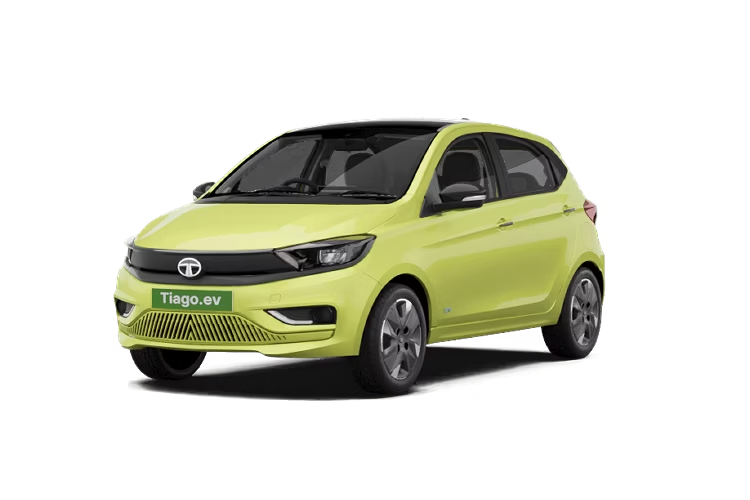
Should You Buy One?
If you’re asking Is the Tata Tiago EV Worth It for a Low Daily Mileage of 20 km, your decision should depend on three factors:
You have access to home charging, you mostly drive within the city, and you plan to keep the vehicle for several years.
Under those conditions, the Tata Tiago EV delivers strong value. The savings may build gradually rather than dramatically, but the lower running costs, comfortable driving experience, and reduced maintenance expenses create a compelling ownership case.
Conclusion
Is the Tata Tiago EV Worth It for a Low Daily Mileage of 20 km? For many Indian city drivers, yes. A daily commute of 20 km fits comfortably within the Tiago EV’s capabilities. You gain lower running costs, fewer maintenance requirements, and the convenience of home charging.
The biggest advantage comes from long-term ownership. Keep the car for several years, and the economics become increasingly attractive. For urban commuters seeking an affordable electric hatchback, the Tata Tiago EV remains one of the strongest options available in the Indian EV market today.
Sources: Tata Motors official specifications, owner-reported usage patterns, and publicly available EV running-cost calculations from Indian automotive industry data.

Dattu Siddi is a Commerce graduate and automobile content writer with over 2 years of blogging experience. Based in Yellapur, Uttara Kannada (Karnataka), he focuses on delivering accurate, easy-to-understand car information using real-world calculations and practical comparisons. Through cardekho24, Dattu publishes clean, user-first automotive content—especially around EVs, budget cars, ownership costs, and real-life usage—to make car research simple, transparent, and trustworthy.
Pingback: The Real Scoop: Tata Tiago EV Charging Time and Cost Per Km