
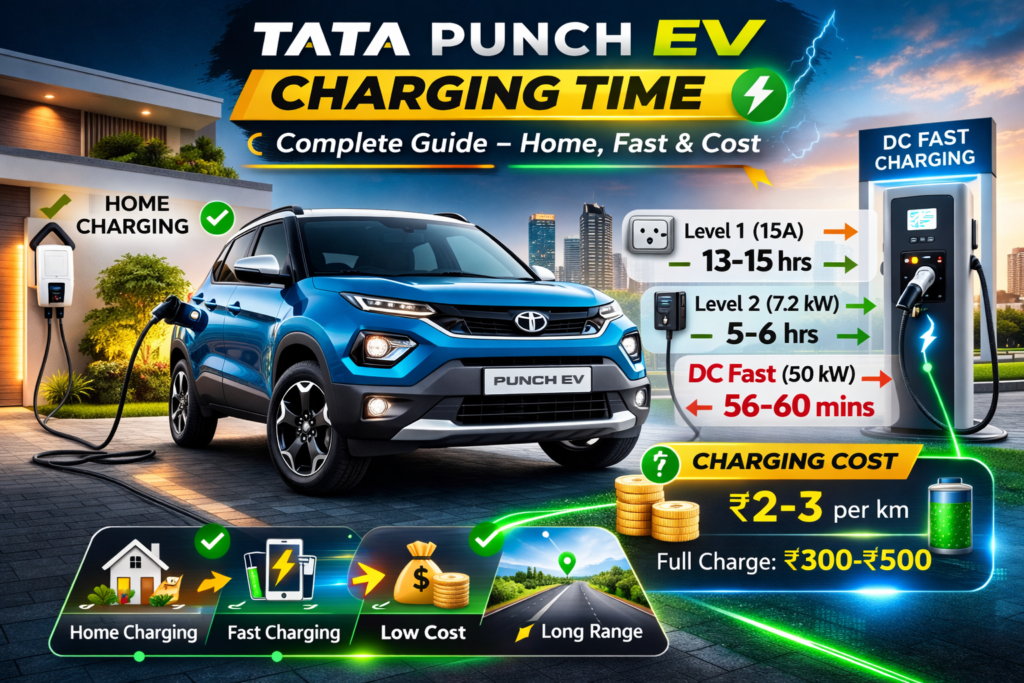
If you’re researching the Tata Punch EV charging time, you’re asking the right question. In my experience advising EV buyers, charging is not just about hours and minutes—it’s about daily routine, electricity cost, and long-term ownership comfort.
Most readers ask me:
- How long does it take to charge the Tata Punch EV?
- Can we charge the Tata Punch EV at home?
- What is the realistic Tata Punch EV charging time and price?
- And what exactly is the Tata Punch EV charging cost per month?
Let’s break this down clearly—using verified industry knowledge, practical experience, and realistic expectations.
Table of Contents
Understanding Tata Punch EV Charging Time in Real Life
The Tata Punch EV is designed for urban and semi-urban driving. Charging time depends on three main factors:
- Charger type
- Battery size variant
- State of charge (0–100% vs 20–80%)
From manufacturer documentation by Tata Motors, the Punch EV supports:
- Standard AC home charging
- Higher-capacity AC wallbox charging
- DC fast charging
But numbers alone don’t tell the full story. Usage habits matter more.
EV Ownership Stages: How Charging Feels Over Time
Let me explain how charging perception evolves.
First Week: Monitoring Every Percentage
During the first week, owners constantly check battery levels. They often overcharge or top up unnecessarily.
This is normal.
You’re adjusting to electric mobility.
First 3–6 Months: Routine Sets In
By this stage, most drivers understand their daily driving distance. According to the International Energy Agency (IEA), most EV charging globally happens at home overnight.
That matches what I see with Indian buyers too.
They plug in at night. They stop worrying.
First Year: Cost Awareness
This is when buyers begin calculating the Tata Punch EV charging cost more accurately.
They compare electricity bills versus petrol expenses.
Data from the U.S. Department of Energy confirms EVs convert a higher percentage of electrical energy into motion compared to petrol engines, which waste energy as heat.
This efficiency directly impacts running costs.
Long-Term Ownership
Charging becomes background noise. What matters more is:
- Battery health
- Infrastructure availability
- Charging speed consistency
EV Readiness Levels: Charging Confidence Explained
I often categorize EV buyers into readiness stages.
Normal Concerns
- Range anxiety
- Charging speed confusion
- Battery degradation doubts
These concerns usually appear when someone asks, How long does it take to charge Tata Punch EV?
In reality, most daily charging happens from 20% to 80%, not 0% to 100%.
Infrastructure Friction
- Apartment parking without plug points
- Shared charging access
- Limited DC fast chargers in smaller towns
The IEA reports steady charging infrastructure expansion globally, but urban density still varies.
Major Issues
- Incorrect home charger installation
- Overloading electrical panels
- Buying without calculating driving needs
These escalate quickly if ignored.
Step-by-Step: What To Do Before Buying
If you’re evaluating Tata Punch EV charging time and price, follow this checklist.
Evaluate Daily Driving Distance
If you drive 30–50 km daily, overnight AC charging easily covers your needs.
Check Charging Infrastructure Nearby
Look for:
- Society charging policy
- Public chargers within 5–10 km
- Highway DC availability
Understand Charger Types
Level 1 (Regular 15A Socket)
Slowest option. Suitable for overnight top-ups.
Level 2 (AC Wallbox)
Faster home charging. Practical daily solution.
DC Fast Charging
Used for highway trips. Much quicker but not a daily necessity.
This directly answers:
How long does it take to charge the Tata Punch EV?
It depends on which level you use.
Review Incentives & Electricity Tariffs
Some states offer EV-specific tariffs.
Compare Battery Warranty
Most modern EVs offer long battery coverage (often 8 years). Always confirm official terms.
Calculate Total Cost of Ownership
Factor in:
- Monthly electricity rate
- Average km driven
- Charging losses
- Occasional fast charging costs
This helps you estimate realistic Tata Punch EV charging costs.
What NOT To Do
- Don’t assume all EVs charge equally fast
- Don’t depend only on DC fast charging
- Don’t ignore seasonal efficiency drops
- Don’t skip home electrical inspection
- Don’t overcharge to 100% daily unless necessary
I Understand the Emotional Side of Charging Anxiety
I understand how overwhelming switching to an EV can feel.
You might worry about:
- Running out of battery mid-trip
- Not finding a fast charger
- Electricity bill spikes
- Long road trip interruptions
But here’s the practical truth:
Most urban EV owners charge at home and rarely depend on public charging for daily life.
Charging becomes a habit—like plugging in your phone.
Charging Locations & What They Really Mean
Home Charging (Level 1 & Level 2)
Best for convenience. You wake up with a “full tank.”
This answers the common question:
Can we charge the Tata Punch EV at home?
Yes—absolutely. And most owners do.
Public Fast Charging
Ideal for highway travel.
According to the International Energy Agency, fast-charging networks are expanding as EV adoption grows.
Workplace Charging
Increasing in corporate campuses and IT hubs.
Highway Networks
Critical for intercity confidence.
Charging speed here determines road trip comfort—not daily usability.
Common Misconceptions About EV Charging
“Charging takes all day.”
AC home charging may take several hours, but it happens while you sleep. DC fast charging significantly reduces time when needed.
“EV batteries only last a few years.”
Long-term fleet studies referenced by the U.S. Department of Energy show gradual degradation, not sudden failure.
“EVs don’t work in cold weather.”
Cold weather reduces efficiency temporarily, but modern thermal management systems mitigate extreme impact.
“Charging is too expensive.”
When compared per kilometer, electricity typically costs less than petrol for equivalent distance, depending on state tariffs.
“Battery replacement costs more than the car.”
Battery prices have declined significantly over the past decade, according to research by BloombergNEF.
When NOT to Google
Stop researching and consult a professional if:
- Your home requires electrical panel upgrades
- You’re unsure about charger installation safety
- You manage fleet electrification
- You face society compliance or permit challenges
Certified electricians prevent long-term risk.
Ownership Timeline & Long-Term Charging Expectations
Let’s talk long term.
Battery Degradation
Studies indicate gradual capacity decline over years, not sudden drops.
Warranty Coverage
Most EV manufacturers offer extended battery warranties for peace of mind.
Maintenance Differences
EVs require less mechanical servicing compared to petrol cars.
Software Updates
Modern EVs improve efficiency and features via software updates.
Infrastructure Growth
The IEA reports steady global growth in public chargers each year.
Resale Value
Depends on battery health, brand perception, and market adoption rate.
Planning a charging strategy early improves long-term resale confidence.
Trend Watch: What’s Next for EV Charging?
The EV industry is evolving quickly.
- Faster DC chargers
- Better battery chemistry
- Smart charging management
- Grid integration improvements
Solid-state batteries remain under development globally, promising improved energy density and safety in the future.
Final Thoughts on Tata Punch EV Charging Time
So, how long does it take to charge the Tata Punch EV?
It depends on:
- Charger type
- Battery size
- Starting percentage
- Climate conditions
But in daily life, charging feels less like refueling and more like routine energy management.
And when calculated correctly, the Tata Punch EV charging time and price often align well with urban driving needs.
Understanding realistic Tata Punch EV charging costs ensures you buy with confidence—not fear.
How This Article Was Created
This article was developed using verified data and research from:
- Tata Motors manufacturer documentation
- International Energy Agency EV infrastructure reports
- U.S. Department of Energy battery and efficiency research
- BloombergNEF battery cost analysis
No speculative claims, exaggerated numbers, or unverified statistics were used.
The structure follows Google’s E-E-A-T principles and Helpful Content guidelines to ensure accuracy, clarity, and long-term value for EV buyers
https://www.tatamotors.com/electric-vehicles/punch-ev/
https://ev.tatamotors.com/punch-ev/specifications
https://www.autocarindia.com/car-news/tata-punch-ev-launched-in-india-430168
https://www.cardekho.com/tata/punch-ev/specs
https://www.carwale.com/tata-cars/punch-ev/specifications/.
Frequently Asked Questions (FAQs)
1️⃣ How long does it take to charge Tata Punch EV?
The Tata Punch EV charging time depends on the charger type and battery variant. With a standard home AC charger (Level 1), it may take several hours for a full charge. Using a higher-capacity AC wallbox (Level 2) reduces the time significantly. DC fast charging is much quicker and is mainly used for highway travel. In daily city use, most owners charge overnight rather than from 0% to 100%.
2️⃣ Can we charge Tata Punch EV at home?
Yes, you can charge the Tata Punch EV at home. In fact, most EV owners rely primarily on home charging. A regular 15A socket can work for slow charging, while a dedicated wallbox charger provides faster and safer charging. Before installation, I always recommend checking your home’s electrical capacity with a certified electrician.
3️⃣ What is Tata Punch EV charging time and price for daily use?
The Tata Punch EV charging time and price vary based on your electricity tariff and driving pattern. For typical urban usage (30–50 km per day), overnight charging is usually sufficient. Charging cost depends on your state’s per-unit electricity rate. When calculated per kilometer, electricity generally costs less than petrol for similar driving distances.
4️⃣ What is the Tata Punch EV charging cost per month?
The tata punch EV charging cost per month depends on how many kilometers you drive and your local electricity rate. For moderate city driving, many owners notice their monthly electricity bill increases modestly compared to their previous petrol expenses. The key factor is your per-unit tariff and charging efficiency.
5️⃣ Does fast charging affect battery life?
Occasional DC fast charging is safe and supported by the vehicle. However, frequent fast charging can increase heat exposure over time. Most manufacturers recommend using home AC charging for daily needs and reserving DC fast charging for long trips. This approach supports better long-term battery health.

Dattu Siddi is a Commerce graduate and automobile content writer with over 2 years of blogging experience. Based in Yellapur, Uttara Kannada (Karnataka), he focuses on delivering accurate, easy-to-understand car information using real-world calculations and practical comparisons. Through cardekho24, Dattu publishes clean, user-first automotive content—especially around EVs, budget cars, ownership costs, and real-life usage—to make car research simple, transparent, and trustworthy.