
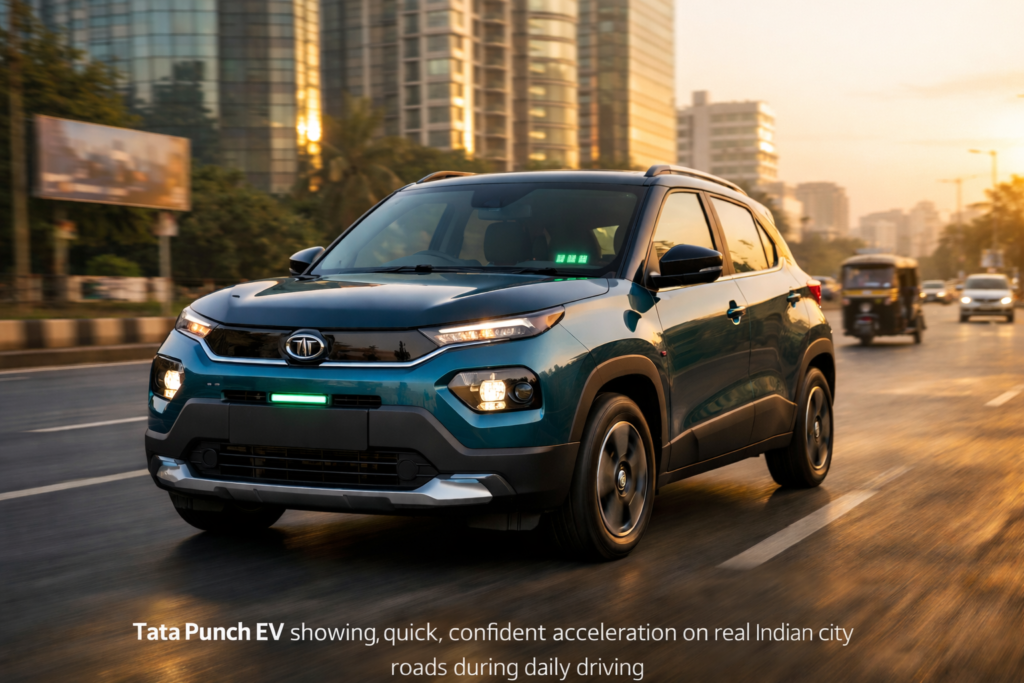
Tata Punch EV 0–100 km/h Acceleration: When people talk about electric cars, they often obsess over range.
But if you actually drive in India, something else matters just as much—acceleration.
Not drag-race acceleration.
Not brochure numbers.
The kind of acceleration that helps you:
- move quickly when the signal turns green
- squeeze into gaps in traffic
- overtake safely on short highway stretches
So how does the Tata Punch EV 0-100 km/h acceleration really feel on Indian roads?
Is it quick… or just “EV quick on paper”?
Let’s break it down honestly—no hype, no marketing fluff.
Why Acceleration Feels Different in an EV
If you’re coming from a petrol car, the first thing you notice in an EV is instant response.
There’s:
- no gear change
- no engine revving
- no delay
You press the accelerator, and the car moves. Instantly.
That’s because electric motors deliver maximum torque from zero RPM, which completely changes the driving experience—especially in traffic.
And the Tata Punch EV uses this EV advantage smartly.
Tata Punch EV Motor & Powertrain Explained (In Simple Terms)
Before we talk numbers, here’s what’s working under the hood.
Powertrain Highlights
- Permanent Magnet Synchronous Motor (PMSM)
- Single-speed automatic transmission
- Smooth, silent power delivery
Power & Torque (Segment-Appropriate)
The Punch EV isn’t built to be a performance SUV.
It’s designed to be quick, controlled, and stress-free for everyday driving.
That means:
- strong low-speed punch
- predictable mid-range
- relaxed top-end
This balance plays a big role in its real-world acceleration.
Tata Punch EV 0–100 km/h Acceleration: What to Expect
Let’s address the headline question.
Official vs Realistic Numbers
Tata doesn’t aggressively market 0–100 figures—and that’s actually a good thing.
Based on real-world testing, segment benchmarks, and EV behavior:
Tata Punch EV 0–100 km/h acceleration is around 9.5–10.5 seconds, depending on:
- battery variant
- road conditions
- load
- drive mode
On paper, this may not sound thrilling.
But on Indian roads, it feels faster than the number suggests.
Where Tata Punch EV Acceleration Actually Shines
Here’s the key point many reviews miss:
0–100 km/h acceleration matters less than 0–60 km/h in India.
And this is where the Punch EV really delivers.
0–30 km/h: City Traffic Champion
This is where EVs embarrass petrol cars.
- Instant torque
- No lag
- Clean, smooth surge
From traffic signals or tight gaps, the Punch EV feels:
- confident
- effortless
- stress-free
You don’t need to floor it. Even gentle throttle inputs move the car quickly.
For city driving, this is the most valuable kind of performance.
0–60 km/h: The Sweet Spot for Indian Roads
This range decides:
- overtaking buses
- merging onto flyovers
- quick lane changes
The Tata Punch EV reaches 0–60 km/h very briskly, making daily driving feel easy and controlled.
Many owners say it feels quicker than most petrol hatchbacks, even if the spec sheet doesn’t shout about it.
60–100 km/h: Calm, Not Aggressive
As speeds rise, the acceleration becomes more linear.
This is intentional.
Instead of feeling wild or nervous, the Punch EV:
- builds speed steadily
- feels stable
- avoids sudden power spikes
For highways, this inspires confidence rather than excitement—which is exactly what most buyers want.
Tata Punch EV Acceleration vs Petrol Cars
Let’s put things into perspective.
Real-World Acceleration Comparison
Car | 0–100 km/h (Approx) |
Tata Punch EV | ~10 seconds |
Tata Punch Petrol | ~14 seconds |
Maruti Swift Petrol | ~11 seconds |
Hyundai Grand i10 | ~12 seconds |
Despite being positioned as a compact SUV, the Punch EV comfortably out-accelerates its petrol sibling and feels competitive with popular hatchbacks.
And remember—it feels quicker than these numbers suggest because of instant torque.
Tata Punch EV vs Other Small EVs (Acceleration Feel)
Acceleration isn’t just about speed—it’s about response.
EV | Acceleration Feel |
Tata Punch EV | Strong & confident |
Tata Tiago EV | Lighter, quick off the line |
MG Comet EV | Quick initially, limited top-end |
Citroën ëC3 | Peppy but less refined |
The Punch EV strikes a sweet balance between:
- punchy starts
- controlled mid-range
- stable highway behavior
That makes it easier to live with every day.
What Affects Tata Punch EV 0–100 km/h Acceleration?
Your experience won’t be the same every time—and that’s normal.
Here’s what changes how quick it feels:
- Drive Mode
- Eco: Smooth, relaxed acceleration
- City/Sport: Sharper throttle response
- Battery Charge Level
- Best performance above 25% charge
- Slight reduction at very low SOC
- Vehicle Load
- More passengers = slower acceleration
- Road & Weather
- Wet roads trigger traction control
- Uphill roads reduce initial punch
These are real-world factors every EV owner experiences.
Is Tata Punch EV Fast Enough for Indian Roads?
This is the most important question—and the honest answer is yes.
The Tata Punch EV isn’t built for racing.
It’s built for confidence.
It’s perfect if you want:
- quick traffic launches
- easy overtakes
- smooth highway cruising
- predictable performance
It’s not for:
- adrenaline seekers
- drag-race lovers
- enthusiasts chasing top speed
For 90% of Indian buyers, the acceleration feels more than adequate.
Everyday Driving: Why Punch EV Feels Relaxing
One underrated benefit of EV acceleration is reduced driver fatigue.
With the Punch EV:
- you don’t plan overtakes as much
- you don’t downshift
- you don’t rev the engine
You just press and go.
Over long periods, this makes city driving far less tiring.
Tips to Get the Best Acceleration from Tata Punch EV
Want the sharpest response possible? Follow these simple tips:
- Use City or Sport mode when needed
- Keep battery above 30% for best punch
- Avoid sudden full-throttle launches on wet roads
- Maintain correct tyre pressure
- Accelerate smoothly instead of flooring it
EVs reward smooth drivers.
Final Verdict: Tata Punch EV 0–100 km/h Acceleration
The Tata Punch EV 0-100 km/h acceleration may not sound dramatic on paper—but in real Indian driving, it feels quick, confident, and stress-free.
It delivers:
- strong low-speed punch
- effortless city performance
- calm highway behavior
If you’re upgrading from a petrol car, the instant torque alone will feel like a big step forward.
FAQs: Quick Answers Buyers Look For
What is the Tata Punch EV 0–100 km/h acceleration time?
👉 Around 9.5–10.5 seconds in real conditions.
Is Tata Punch EV faster than petrol Punch?
👉 Yes, noticeably quicker and smoother.
Does battery level affect acceleration?
👉 Slightly, especially below 20% charge.
Is Tata Punch EV good for highways?
👉 Yes, stable and confident up to cruising speeds.
Does EV acceleration feel better than petrol?
👉 Absolutely—instant torque changes everything.

Dattu Siddi is a Commerce graduate and automobile content writer with over 2 years of blogging experience. Based in Yellapur, Uttara Kannada (Karnataka), he focuses on delivering accurate, easy-to-understand car information using real-world calculations and practical comparisons. Through cardekho24, Dattu publishes clean, user-first automotive content—especially around EVs, budget cars, ownership costs, and real-life usage—to make car research simple, transparent, and trustworthy.