
BYD Emax 7 battery capacity matters more than you might think—it’s the heart of the drive and what defines how far you can go without charging. This understanding would help you decide if the BYD Emax 7 fits your lifestyle, whether it’s a daily city commute or weekend getaways.
Table of Contents
What exactly is the BYD Emax 7 battery capacity?
Battery capacity, when it comes to the BYD Emax 7, is not a single fixed number. Instead, the EV comes with two differing battery pack options depending on which variant you opt for: a “Premium” trim with a 55.4 kWh battery pack and a “Superior” trim with a 71.8 kWh battery pack.
This dual-option approach gives buyers flexibility: a smaller battery for those mostly driving in town and a larger pack for those buyers needing longer range or taking longer trips.
How much driving range does each battery option deliver?
The company claims a range of about 420 km on a full charge if you go for the 55.4 kWh battery pack in the Premium variant. For many city dwellers or small families, that’s more than enough for daily errands, commutes, and occasionally much longer drives.
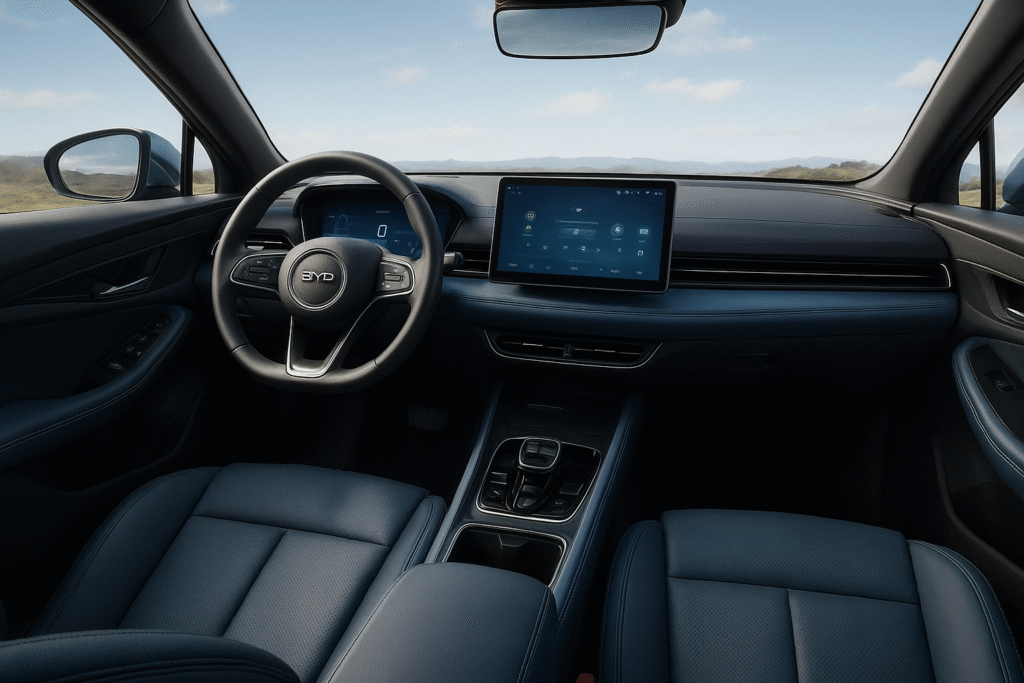
On the other hand, the 71.8 kWh battery in the Superior variant bumps up the claimed driving range to approximately 530 km per charge. That makes the Emax 7 appealing if you often do longer distances, especially on highways or intercity routes.
Battery type and technology behind the scenes
The battery in the Emax 7 is the well-regarded “Blade Battery,” using a lithium-iron-phosphate (LiFePO₄) chemistry—a choice known for safety, stability, and longevity compared to many other EV battery types.
Putting the battery under the floor pan optimizes weight distribution and helps in keeping the cabin and storage space more usable.
Charging—What to expect
Charging the Emax 7 is pretty straightforward, and there are options. On a compatible DC fast charger, the battery can be taken from 0 to 80% in around 37 minutes for both battery variants—though some sources reference a 30-minute estimate for the larger pack under optimal conditions.
For overnight charging at home or the workplace, the Emax 7 supports AC charging via a 7 kW charger—useful if you don’t need to top up quickly and want convenience by morning.
Real-world vs. claimed range: what to keep in mind
While the claimed ranges of 420 km and 530 km are useful benchmarks, real-world range may vary depending on driving habits, traffic conditions, and usage of accessories like AC, lights, and infotainment.
In fact, independent real-world testing in traffic-heavy conditions—with AC and other loads—has reported lower effective range, especially under the circumstances of frequent stop-and-go driving or frequent slowing and speeding up.
With that said, thanks to an efficient Blade Battery and well-designed battery management system, the Emax 7 does tend to deliver a reasonable portion of its claimed range—often enough for most city-to-city drives without range anxiety.
How BYD’s battery capacity choices affect daily use
Statistical snapshot
| Year | Stat | Source |
| 2024 | Battery options 55.4 kWh & 71.8 kWh | BYD official specs / Auto-data.net |
| 2024 | Claimed range: 420 km (55.4 kWh) / 530 km (71.8 kWh) | Autocar India / Cars24 / Times Drive |
| 2024 | 0–80% DC fast charging in ~37 minutes | EV Database / v3Cars |
Grapes-style comparison: Pros, cons, and Features
| Feature/Factor | Premium 55.4 kWh version | Superior 71.8 kWh version | Comments |
| Battery Capacity | Smaller, lighter | Larger, heavier | A smaller battery may slightly improve handling; a larger one gives more range |
| Claimed Range | ~420 km | ~530 km | A larger battery better for long drives |
| Charging Time (DC) | ~37 min 0–80% | ~37 min 0–80% | Similar fast-charging convenience |
| Cost/Affordability | Lower upfront cost | Higher cost | 55.4 kWh variant often more budget-friendly |
| Use Case Suitability | City driving, short trips | Long commutes, travel, highway use | Pick as per driving needs |
| Cabin/Seating Space | Same for both | Same for both | Battery placement doesn’t affect seating or boot layout |
| Battery Technology (Blade, Life PO₄) | Yes | Yes | Both benefit from safe, stable battery design |
| Longevity / Real-world usability | Good for regular use | Better buffer for frequent long trips | A larger battery reduces range-anxiety risk |
Why BYD’s battery strategy matters for Indian buyers
Given the different driving patterns of India, from small urban commutes to long outstation trips, battery options are a big plus. Many buyers may not need 500+ km of range every day; for them, the 55.4 kWh pack offers a lower-cost entry into EV life with enough range.
The 71.8 kWh pack is all the more useful for families or individuals who will use the Emax 7 frequently on long drives, such as weekend trips, highway journeys, or even long-distance commuting.
Also, the fact that both variants use the same sort of “Blade Battery” with LiFePO₄ chemistry brings assurance for safety, thermal stability, and longevity—factors that matter considerably in hot climates like India’s.
Common questions answered
Some may wonder if the smaller battery is going to make the car significantly weaker or slower. In the case of Emax 7, the smaller 55.4 kWh pack drives a motor that’s still very usable and handles everyday traffic well. For city driving and school runs or grocery trips, it’s more than enough.
Others ask, “Will the bigger battery survive long years of use?” The LifePO₄ chemistry of the Blade Battery, combined with a good battery management system, suggests long-term durability. Occasional fast charging should not harm it—but regular moderate charging (like overnight AC charging) is often gentler on battery life.
If you intend to use the car mainly within city limits, only taking it for the occasional longer trip, then opting for the 55.4 kWh version probably offers the best balance of convenience, cost, and practicality. But if longer journeys or frequent travels are in the cards, then the 71.8 kWh pack provides that extra buffer that adds comfort and reduces “range anxiety.”
Conclusion
The BYD Emax 7 battery capacity is more than just a technical detail, as it shapes how you use the car, how much range you get between charges, and how well the vehicle matches your lifestyle. With two options for batteries—55.4 kWh and 71.8 kWh—you can get a choice that truly meets your driving pattern, whether for city commute efficiency or long-distance cruising.
If you mainly drive around town, the 55.4 kWh battery will serve you well without the extra cost. But if you expect to travel farther, say on highways and long trips, or with the family, then the 71.8 kWh battery, with its 530 km claimed range, is a more compelling choice.
In other words, choose your battery according to your use case. And when you come to realize that, the BYD Emax 7 is no longer just an electric MPV; it’s an EV that can flexibly adapt to real-world needs. Consider all that, and you arrive at a point of smart, informed decision-making for yourself that keeps you moving without surprises.

Dattu Siddi is a Commerce graduate and automobile content writer with over 2 years of blogging experience. Based in Yellapur, Uttara Kannada (Karnataka), he focuses on delivering accurate, easy-to-understand car information using real-world calculations and practical comparisons. Through cardekho24, Dattu publishes clean, user-first automotive content—especially around EVs, budget cars, ownership costs, and real-life usage—to make car research simple, transparent, and trustworthy.